Concrete panel fence — what it is and who it suits
Grooved posts, panels and a foundation: what a precast concrete fence consists of, how it is assembled, how much it costs and which properties it suits. A typical fence is assembled in 2–3 days on a prepared site.
A precast concrete fence is a fence made of ready-made elements: concrete posts and panels that are produced in a factory and assembled on your property. Only the foundation is poured on site; the fence itself is assembled, not built of masonry.
What is a precast concrete fence?
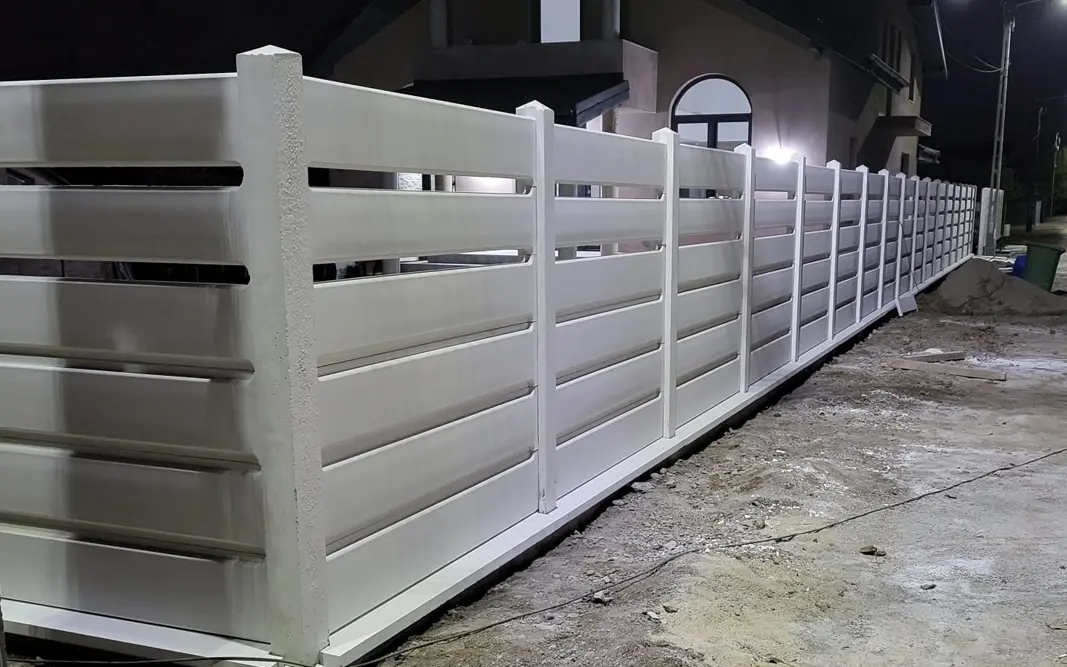
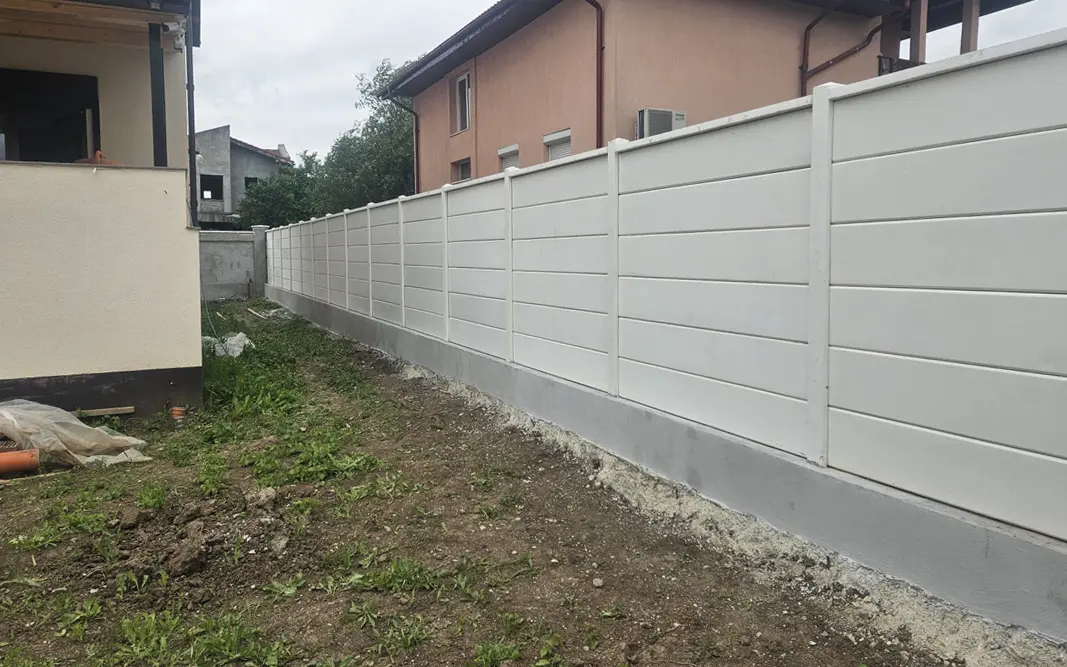
Concrete posts with longitudinal grooves are set along the fence line, and between every two posts panels are stacked — one on top of another until the desired height is reached. With the solid models the result is a wall without gaps that screens the yard from the street.
With a masonry fence everything is done on site — brick by brick, then render. With a precast one the posts and panels arrive ready-made from the factory, cast to one and the same recipe, and only the foundation and the stacking are left for the site. A comparison with masonry is in the article concrete or brick fence.
What does the fence consist of?
There are three elements:
| Element | What it is |
|---|---|
| Posts | the standard ones are 285 cm long, of which 80 cm stay in the ground |
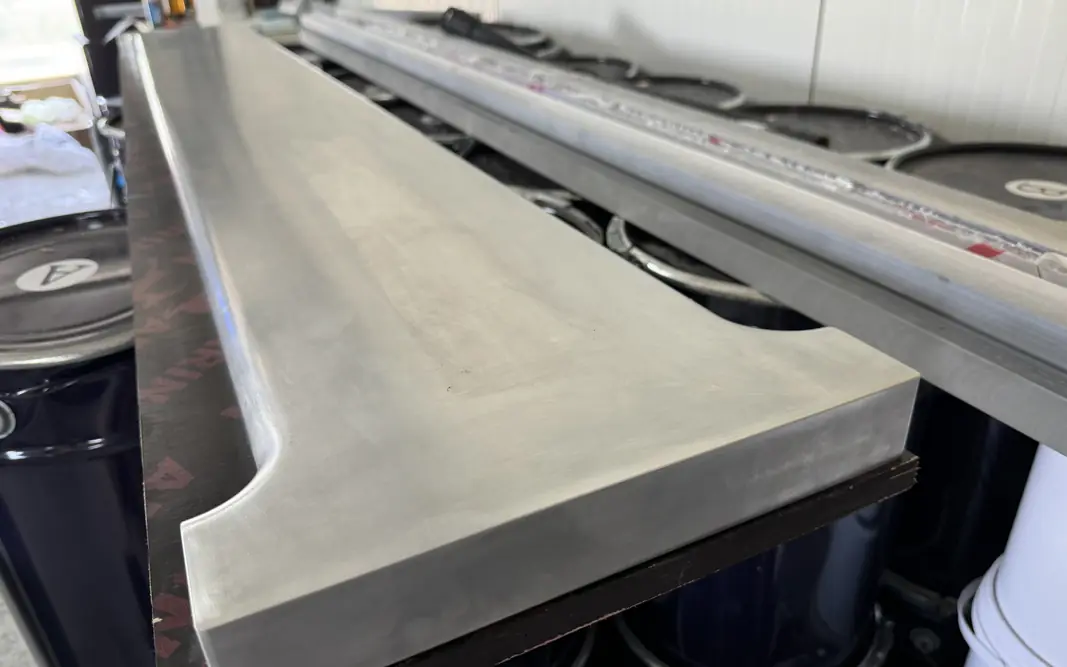
| Panels | for most models 183 × 30 × 4–5 cm (thickness depending on the relief), weighing 46–61 kg depending on the model |
| Foundation | individual footings under the posts; on difficult ground they are connected by a strip plinth |
The height is determined by the number of rows of panels: for most models 150 cm is 5 rows, 180 cm — 6 rows, and 210 cm — 7 rows. The exceptions are the three models with larger panels: Douglas and Cedar (200 × 40 × 4–5 cm) are available in heights of 160 and 200 cm, and Stacked Stone (200 × 50 × 4–5 cm) — in heights of 150 and 200 cm. With 183 × 30 cm panels the fence can also be 240 cm high (8 rows) — with reinforced K9i posts 310 cm long; its price is in the price list.
The panels and posts are made of reinforced concrete with conventional steel-bar reinforcement. The colour is in the concrete itself, not in paint: the standard finish is grey, and the premium finish is white, with white Portland cement and marble aggregate.
The relief is on the front face of the panel, and the back is left unfinished. There are 22 models: seven in Modern Line, six in Simple Line, four in Aero Line and five in Nature Line. There are geometric reliefs, stone, boards and classic motifs; four models are openwork and let light through. Which model suits which yard — in the article how to choose a concrete fence model.
Request a quote Send us the length and height — the quote is usually ready within 4 working hours.
How is it assembled?
Three steps:
- The foundation. A concrete footing measuring approximately 40 × 40 × 80 cm is poured under each post. On unstable soil or a pronounced difference in level, the footings are connected by a strip plinth with a cross-section of about 20 × 70 cm.
- The posts. They are fixed in the footings and levelled.
- The panels. They are stacked one on top of another in the grooves of the posts — without mortar and without additional bracing. With individual footings the first row of panels is sunk 5–10 cm into the ground.
The assembly itself of a typical fence — from a few dozen to about 100 linear metres — takes 2–3 days on a prepared site with the materials delivered; for longer fences the timeframe is stated in the offer. Fences are also assembled in winter — at temperatures above −5 °C and on snow-free ground; more in the article fence assembly in winter.
The whole process is described in the article how a precast concrete fence is assembled, and the choice of foundation — in individual footings or a strip plinth. Animations of the two options are on the fence assembly page.
What are its advantages?
Once assembled, the fence is not painted and not treated against corrosion: the colour is in the concrete itself and there is no coating to renew. Its service life is over 50 years — concrete does not rot or rust. If it is hit, only the broken panel is replaced: the panels above it are lifted, a new one is put in and they are put back.
The elements arrive by lorry, so access to the property and space for unloading are needed. The foundation is chosen according to the ground; on a slope — see the article fence on sloping ground. How many years the fence lasts and what that depends on — in the article how long a concrete fence lasts.
Who is it suitable for?
- For the yard of a house or villa — the solid models screen the yard from the street.
- For a long fence — the panels are cast to one recipe and are identical from the first to the last.
- For a plant, warehouse or industrial plot — above 200 linear metres Rain Guard, Liner, Simple and Stacked Stone have an industrial price, lower per linear metre, in grey and in white; for shorter fences the standard prices apply. More on the industrial fences page.
- For a yard you do not want to close off — the openwork Lights, Avalon, Visio and Space let light through.
Concrete is not the right solution for every property. For a large agricultural plot, for temporary fencing or in a place with a view you do not want to block, mesh is the more sensible choice — the comparison is in the article concrete fence or mesh fence. If you are hesitating between concrete and metal, see concrete or metal fence.
How much does it cost and what is the warranty?
Standard prices range from 37 to 129 €/m excl. VAT depending on the model, height and colour; the warranty is 15 years. The price includes the panels and posts; transport is stated in the offer, and installation is quoted separately, on request. The price of each model is in the price list; how it is calculated — in the article how much a concrete fence costs.
The warranty applies to all fences, including the industrial offer — with a warranty card and a certificate of conformity.
Where to start?
Browse the models and prices and the photos in the gallery. Then send us the length of the fence, the desired height and a few words about the site via the contact form — you usually receive an offer for the elements and transport within 4 working hours, and if you want installation, after confirmation we also prepare a quote for it. The steps from there on are on the how we work page.