Foundations for a concrete fence — how deep and which option
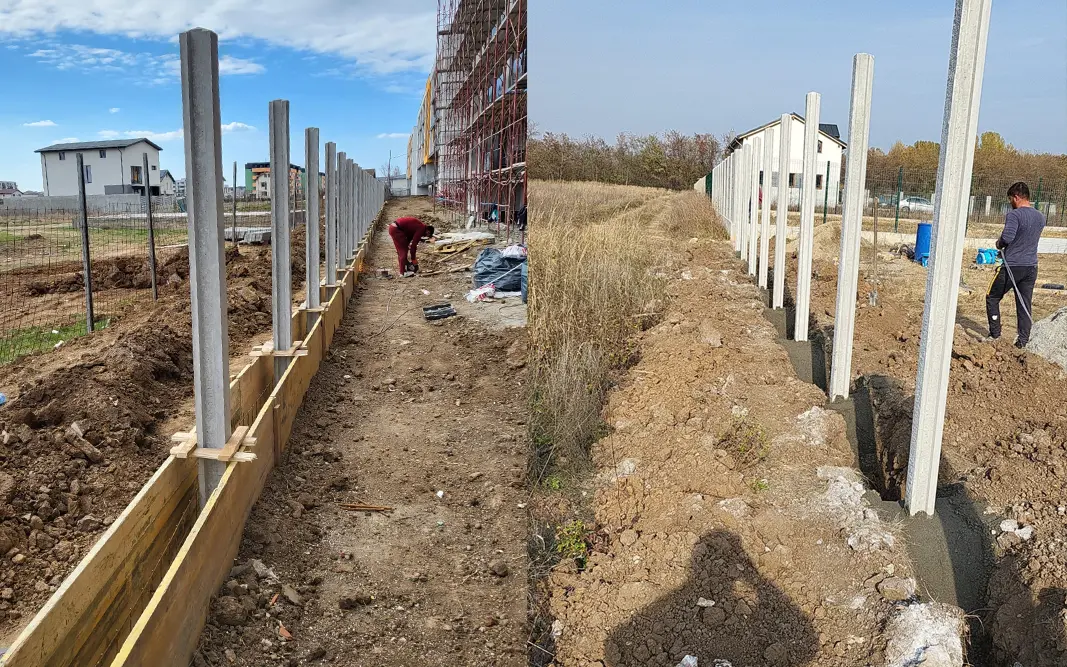
Individual footings (about 40 × 40 × 80 cm under each post) are the cheaper installation for stable ground; a strip plinth (about 20 × 70 cm along the whole line) is for unstable ground and level differences. The plinth costs more, but it closes the bottom edge and can be rendered or clad.
Individual footings under each post are the cheaper installation and are sufficient on stable, fairly level ground; a strip plinth along the whole line is for unstable ground and large level differences. The foundation determines the installation price and how the bottom edge of the fence will look.
What are the two options?
With individual footings, we dig and concrete only under the posts — about 40 × 40 × 80 cm. The ground between them is left untouched, and the first row of panels is sunk 5–10 cm into the ground so that there is no gap underneath. It is cheaper and quicker.
With a strip plinth, a continuous concrete base with a cross-section of about 20 × 70 cm is poured along the entire length. It needs more concrete, reinforcement and formwork — more time and a higher price — but the load is spread along the whole line.
| Criterion | Individual footings | Strip plinth |
|---|---|---|
| Dimensions | ~40 × 40 × 80 cm under each post | ~20 × 70 cm along the whole fence line |
| Installation price | lower | higher |
| Suitable ground | stable, relatively level | unstable, with level differences |
| Bottom edge | the first row is sunk 5–10 cm into the ground | the fence stands on the plinth |
| Subsequent finishing | no visible base | can be rendered or clad |
Option 1 — individual footings (the cheaper installation)
Standard posts are 285 cm, of which 80 cm remain in the concrete; together with the first row of panels sunk 5–10 cm into the ground, they are sufficient for fences up to 210 cm. For a higher fence, reinforced 310 cm posts are used — a higher fence takes more wind load, and the foundation must allow for that.
Individual footings are for stable and fairly level ground — especially with a long fence. The weight of the panels is carried by the posts, so a continuous base is not necessary everywhere. On most models the panel is 183 × 30 × 4–5 cm (thickness depending on the relief) and weighs 46–61 kg; on Douglas and Cedar it is 200 × 40 × 4–5 cm and 77 kg, on Stacked Stone 200 × 50 × 4–5 cm and 82 kg.
When it is not suitable: filled-in and unconsolidated ground, pronounced level differences along the fence line and very windy locations. In those cases a plinth is used.
Request a quote Send us the length and height — the quote is usually ready within 4 working hours.
Option 2 — strip plinth (for difficult ground)
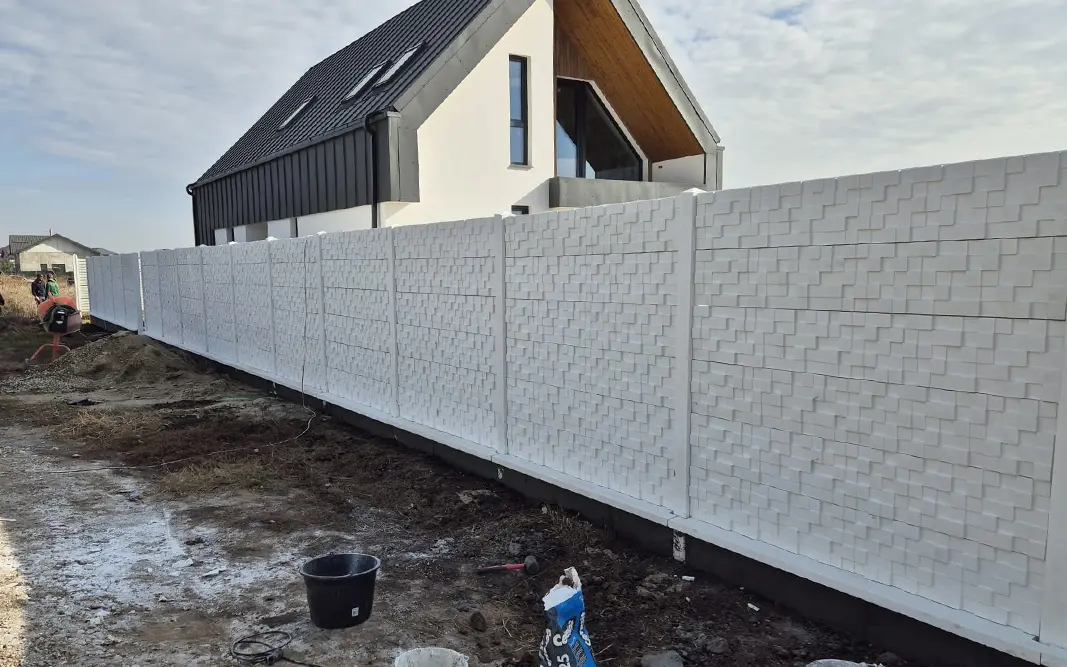
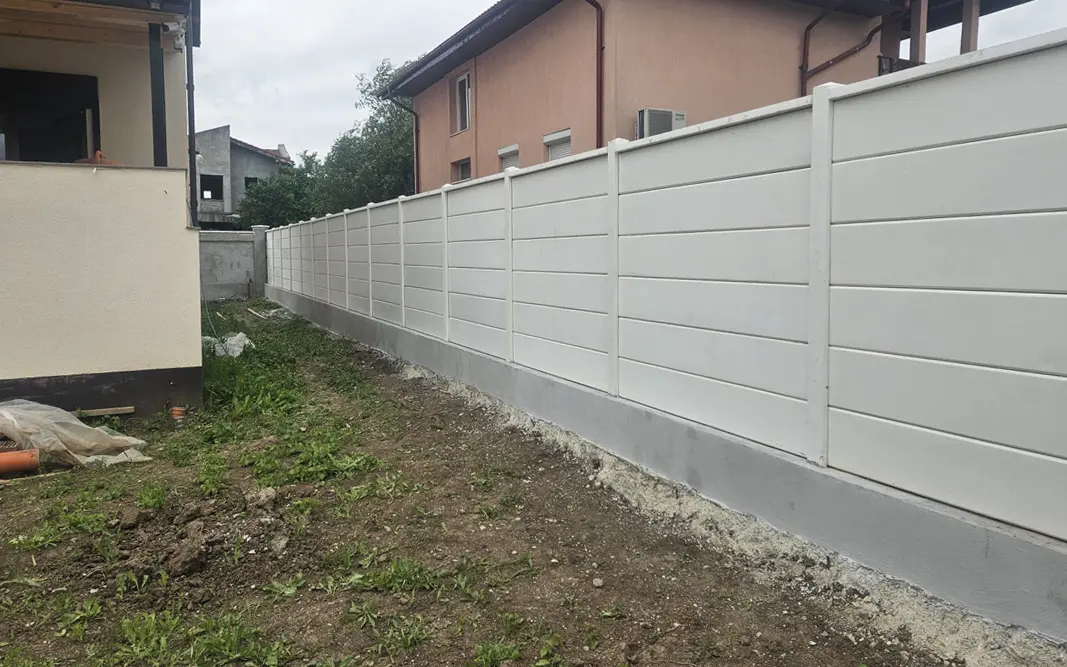
The plinth is for unstable ground and level differences. The continuous base spreads the weight, closes the bottom edge tightly and gives a straight line even when the garden slopes. Part of the plinth remains visible above ground — exactly how much is decided on site according to the slope and the level of the future landscaping.
The plinth can be rendered or clad later to match the façade of the house. The 15-year warranty applies provided the fence is not treated with unsuitable materials — for example oils or cement mix in the joints. The full terms are in the warranty card you receive with the fence.
When it is not needed: level, stable ground with no special requirements. Individual footings are then sufficient; a plinth only makes sense if you want a visible base for rendering or cladding.
How to choose
Budget
Individual footings are the cheaper installation — less concrete, less labour, a shorter lead time; over a long perimeter the difference adds up. The elements themselves — panels and posts — cost between 32 and 129 €/m depending on the model and height; the lower limit is the industrial price for fences longer than 200 linear metres, in grey and in white, while the model's standard prices apply to shorter fences. For 18 of the 22 models you pay 48, 56 or 63 €/m in grey and 79, 92 or 104 €/m in white, depending on the height of 150, 180 or 210 cm; the full range is in models and prices. Prices are excl. VAT; transport is stated in the quote, and installation is quoted separately, on request.
Ground
Stable, well-settled ground — footings. Filled-in, waterlogged or unconsolidated ground — a plinth. If you are not sure what the ground is like, on-site photos and a short description are usually enough for us to assess it.
Level difference
A slight slope can also be handled with individual footings. With pronounced steps and a large difference in levels, a plinth gives an even, controlled line along the whole fence line.
What the installation price depends on
- the distance to the site and access to the perimeter
- the height of the fence (150, 180 or 210 cm on most models), i.e. the number of panel rows
- the size of the footings or the cross-section of the plinth
- the type of soil and obstacles along the fence line — roots, old foundations, concrete
- the season and the weather
- the urgency of the job
Lead times and season
A typical fence — a few dozen up to about 100 linear metres — takes 2–3 days to assemble once the ground is prepared and the materials have been delivered; for longer fences the lead time is stated in the quote. Production runs all year round because our three production halls are enclosed, and we install in winter too — at temperatures above −5 °C and on ground free of snow.
The deposit is at least 20%, and production starts once it is paid. The balance is paid before each delivery — the value of that delivery minus the proportional part of the deposit; with a single delivery, the full balance is paid at once, before the fence leaves the factory. The steps are described on the „How we work“ page, and the answers to the most common questions — in the frequently asked questions.
Send us the length of the fence, the height you want and a few photos of the site — you usually receive a quote for the elements and transport within 4 working hours; if you would like installation, once you confirm the quote we also prepare an installation quote for your site. Write to us here.