How much a concrete fence costs per linear metre (2026 prices)
What determines the price per linear metre — the model, the height, the colour and the type of installation — and a calculation by panels and posts for a 20-linear-metre fence. How to compare two quotes with different prices.
Our usual prices for 2026 range from 37 to 129 €/m excl. VAT, panels and posts included, and the industrial offer for fences over 200 linear metres starts from 32 €/m. Where your fence falls within this range depends on the model, the height and the colour. Transport is added in the quote; installation, if you wish, is quoted separately.
The price range for 2026
Including the industrial offer, our prices for the elements are between 32 and 129 €/m excl. VAT. Within this range there are three zones:
- residential fence in grey (standard): 37–78 €/m, for most models 48–63 €/m
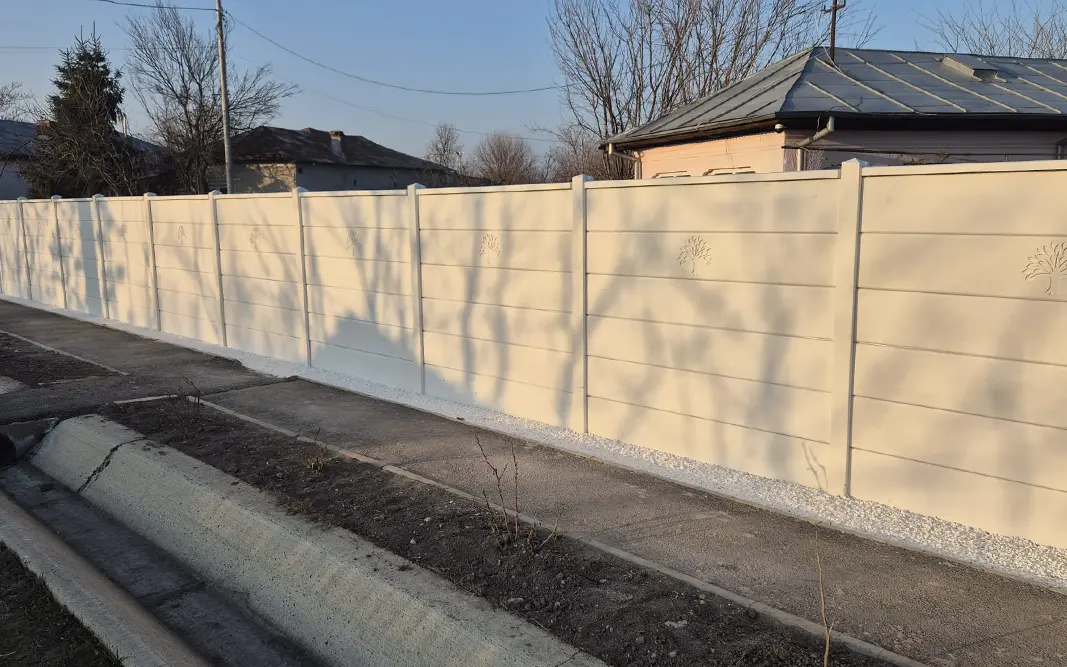
- residential fence in white (premium): 61–129 €/m, for most models 79–104 €/m
- industrial offer: 32–93 €/m — for fences longer than 200 linear metres, in grey and in white; for shorter fences the model's usual prices apply
You will find the price of each model by height and colour in the price list, and the models themselves on the fences page.
What moves the price up and down
The model and its purpose
With us, 18 of the 22 models cost the same at the same height and colour — the relief does not make the panel more expensive, so you choose by taste. The other four have separate prices: Space is more expensive, while Stacked Stone, Douglas and Cedar have larger panels and other heights.
The price also depends on the length. For a fence over 200 linear metres — a factory, a warehouse, a logistics base — Liner, Simple, Rain Guard and Stacked Stone also have an industrial price, which is lower, in grey and in white. For Liner, Simple and Rain Guard it is 43, 49 and 56 €/m in grey and 72, 82 and 93 €/m in white for heights of 150, 180 and 210 cm; for Stacked Stone — 32 €/m at 150 cm and 40 €/m at 200 cm in grey, 54 and 66 €/m in white. For shorter fences the same models are at their usual prices; the terms of the industrial offer are on the industrial fences page.
The height of the fence
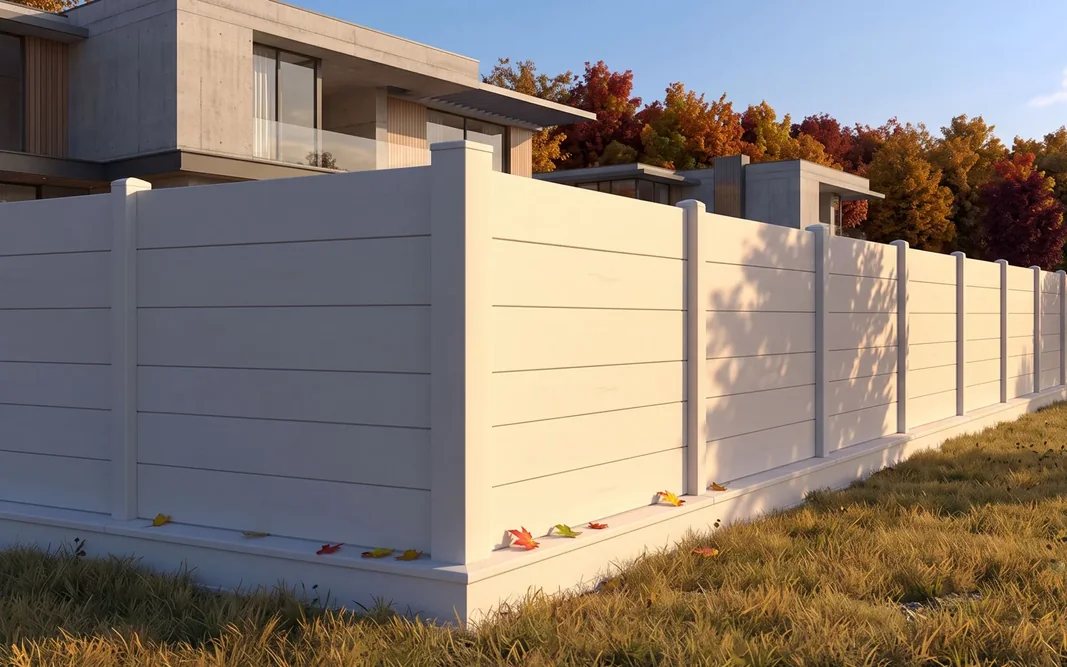
For most models the fence is assembled from 183 × 30 × 4–5 cm panels (thickness depending on the relief) weighing 46–61 kg depending on the model, which are stacked one on top of the other between the posts. The standard heights are 150, 180 and 210 cm — 5, 6 and 7 rows of panels respectively. Three models have other heights. For Douglas and Cedar the panel is 200 × 40 × 4–5 cm and weighs 77 kg, and the heights are 160 and 200 cm — 4 and 5 rows. For Stacked Stone the panel is 200 × 50 × 4–5 cm and weighs 82 kg, and the heights are 150 and 200 cm.
Each extra row on top is one more panel per bay, which is why the price of the same model rises with the height. For most models — 18 of the 22 — the prices by height are:
| Height | Grey (standard) | White (premium) |
|---|---|---|
| 150 cm | 48 €/m | 79 €/m |
| 180 cm | 56 €/m | 92 €/m |
| 210 cm | 63 €/m | 104 €/m |
The prices of the other four models are:
- Space (150, 180 and 210 cm): in grey 59, 68 and 78 €/m, in white 98, 114 and 129 €/m;
- Douglas and Cedar (160 and 200 cm): in grey 57 and 69 €/m, in white 95 and 114 €/m;
- Stacked Stone (150 and 200 cm): in grey 37 and 45 €/m, in white 61 and 75 €/m.
For a height of 240 cm the posts are reinforced — K9i, longer and more massive. The price follows the same formula and is shown in the price list; for taller fences it is set by quote.
Grey or white
Grey is the standard. The white panels are cast from white Portland cement and marble aggregates — a different, more expensive material, not a different shade; that is why a metre in white costs more.
The type of installation
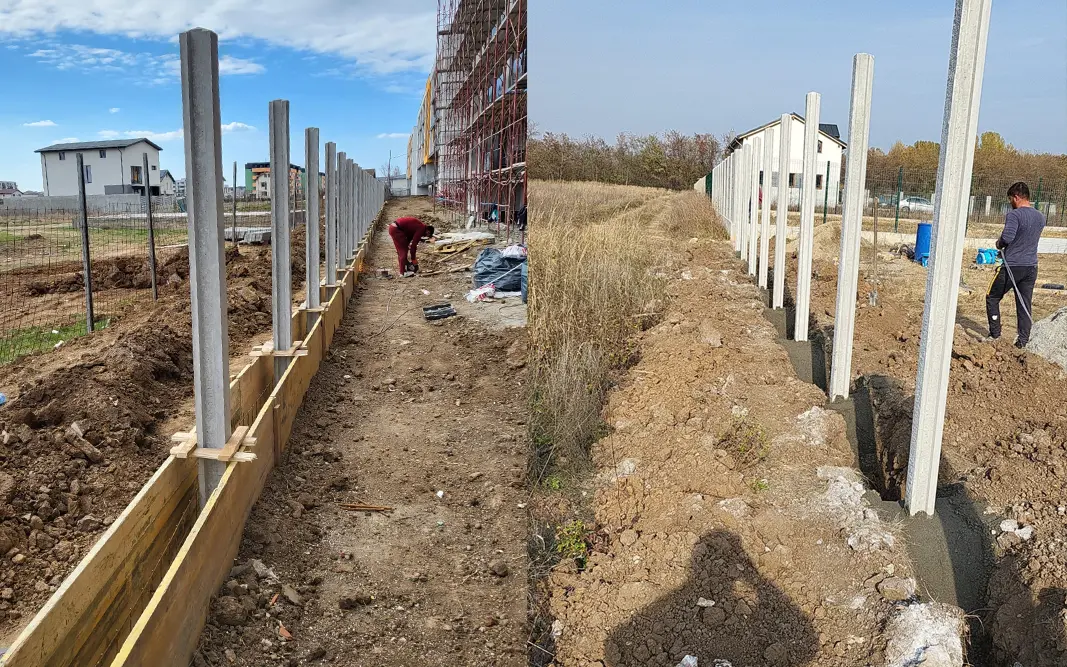
The foundation can be done in two ways. Individual footings of about 40 × 40 × 80 cm under each post — the cheaper option, in which the first row of panels is set 5–10 cm into the ground. Or a strip plinth of about 20 × 70 cm — on unstable soil or with a greater level difference. The two options are compared in the article individual footings or a strip plinth.
If the ground is sloping, see the solutions for level differences and the installation method before comparing quotes.
Transport and length
Transport is not included in the price per linear metre: it depends on the address and the quantity and is stated in the quote for the elements. It is calculated per lorry (half or full), not per linear metre; the exact amount is in the quote.
Request a quote Send us the length and height — the quote is usually ready within 4 working hours.
Example: a 20-linear-metre fence
For 20 linear metres, the calculation for the fence elements — panels and posts, excl. VAT — looks like this:
- grey residential fence: 740–1560 €, for most models 960–1260 €
- white premium fence: €1220–2580, for most models €1580–2080
The lower figure in each row is for the model's lowest height (150 or 160 cm), and the upper one is for 210 cm. A concrete example: 20 m of the Simple model in grey at a height of 180 cm is 11 bays of 1.90 m: 66 panels × €14 + 12 posts × €21 = €1176 excl. VAT — the same amount the configurator shows on the model page (approximately: 20 × €56 = €1120).
Transport is calculated separately according to the address and quantity, and is added to this amount in the quote. The figures above are a guide based on the price list; the final price is in the quote.
At the same height, the difference between grey and white over this length is €480–1020 depending on the model, and for most models €620–820. That is why the colour is decided at the start.
The price list also gives the price of a single panel and the price of each post individually — for calculations based on your own design or for additional posts: for a corner, for the end of the fence or for a branch.
How to compare two quotes with different prices
When comparing quotes from different manufacturers, first check whether the price per metre includes the posts or whether they are charged separately. With a quote per linear metre, also ask whether it includes the foundation, assembly and transport. Then there are two groups of questions.
What you can see:
- the model and the colour;
- the precision of the relief — clear lines and edges, without blurred areas;
- the concrete surface — even, without air pockets or chipped edges.
What you cannot see:
- the strength of the concrete — its compressive strength class;
- the reinforcement — what it is and how it is positioned in the element;
- the dimensions of the panel, above all its thickness, and its weight;
- the density of the concrete and how much water it absorbs.
The quality of the concrete cannot be seen with the naked eye, yet it determines how long the fence will last. Ask every seller for the technical data of the elements, a sample or an already installed fence that you can inspect up close, and the documents — test reports and a certificate of conformity.
Ask us the same questions: the panels are made of reinforced concrete with 42.5R Portland cement, with a compressive strength above 55 MPa at 28 days, and we test the concrete in our own laboratory. The relief and surface of installed fences — in the gallery.
What the quote includes
We usually send the quote for the elements and transport within 4 working hours of the enquiry. It includes:
- the panels, the posts and the necessary additional elements for the specific configuration;
- transport to the site.
If you confirm this quote and want installation, we prepare a separate quote for it according to the site, length, height and foundations; installing a typical fence takes 2–3 days with prepared ground and delivered materials. Once you have the full calculation — the elements and the transport and, if you wish, installation — we confirm the order: contract, invoice and a deposit of at least 20% by bank transfer, and production begins. The balance is paid before each delivery — the value of that delivery, from which the deposit paid is deducted proportionally. With a single delivery, the whole balance is paid at once, before the fence leaves the factory.
For all fences — including those under the industrial offer — we give a 15-year warranty, with a warranty card and a certificate of conformity. The expected life of the fence is over 50 years. The warranty applies provided the fence is not treated with unsuitable materials — for example oils or cement in the joints between the panels. The full terms are set out in the warranty card.
The back of the fence is unfinished — without relief and without finishing. If desired, it can be skimmed with adhesive and fibreglass mesh at any time after assembly; this is not part of standard assembly.
When it can be assembled
Production runs all year round, because the three halls are enclosed. Assembly is possible at temperatures above −5 °C and on ground without snow; there are pauses only in the coldest weeks of January and February. If you are planning the fence for spring, winter is a good time to request a quote — there is more on the subject in the article on assembly in winter.
More answers on lead times, ground and finishing — in the frequently asked questions.
Get an exact price
Send the length of the fence, the desired height and a few photos of the ground via the contact form — you will usually receive a quote for the elements and transport within 4 working hours, and if you want installation, we prepare a separate quote for it once you confirm.