Precast or poured concrete fence — which to choose
A precast fence made of concrete panels is cast in a factory and installed in 2–3 days on prepared ground; a poured (monolithic) fence is made on site, in formwork and in stages. A comparison by time, concrete control, season, appearance, repair and price — and when each is the better choice.
A precast concrete fence is cast in a factory and only assembled on site: a typical fence is ready in 2–3 days with the ground prepared and the materials delivered. A poured, or monolithic, fence is made on site — formwork, reinforcement, concrete, waiting for it to harden, then striking the formwork and finishing. A poured fence is the better choice when the wall has an unusual shape or has to retain soil. For a typical solid fence around a garden, precast works out faster and at a price you know in advance.
Comparison by criteria
| Criterion | Precast (from panels) | Poured (monolithic) |
|---|---|---|
| Where it is made | panels and posts are cast in a factory, in covered halls | on site, in formwork |
| Work on site | concreting the posts and stacking the panels; 2–3 days for a typical fence | formwork, reinforcement, pouring, curing, stripping, finishing |
| The concrete | batched automatically, one mix for every batch | depends on the delivery and on the crew |
| Weather and season | production runs all year round; assembly above −5 °C and on snow-free ground | pouring and curing depend on the weather outside |
| Appearance | 22 models, the relief is cast in silicone moulds, the colour is in the concrete | depends on the formwork; often rendered and painted |
| Repair | only the damaged panel is replaced | repair on site, on the wall itself |
| Shape | straight bays between posts, stepped on a slope | free: curves, angles, different heights |
| Price | public, per linear metre, from 37 €/m excl. VAT | quoted by the contractor |
How long it takes on site
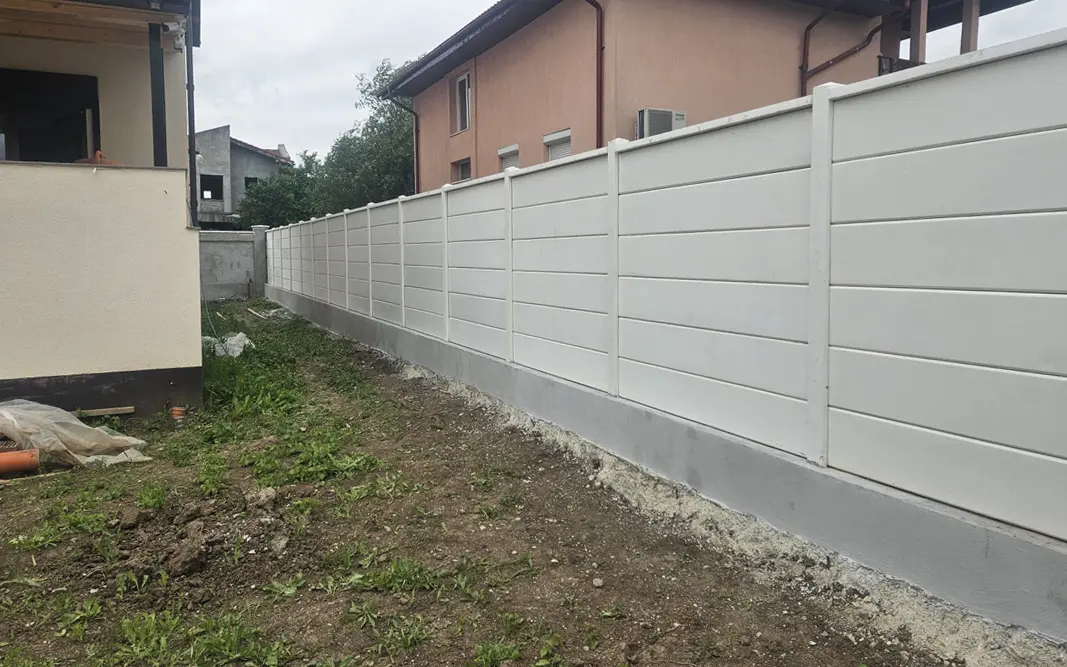
With a precast fence, the factory does most of the work. On site, our installation crew pours the footings, concretes the posts and stacks the panels in their grooves. A typical fence — a few dozen up to about 100 linear metres — is ready in 2–3 days with the ground prepared and the materials delivered; for longer fences the timeframe is stated in the quote.
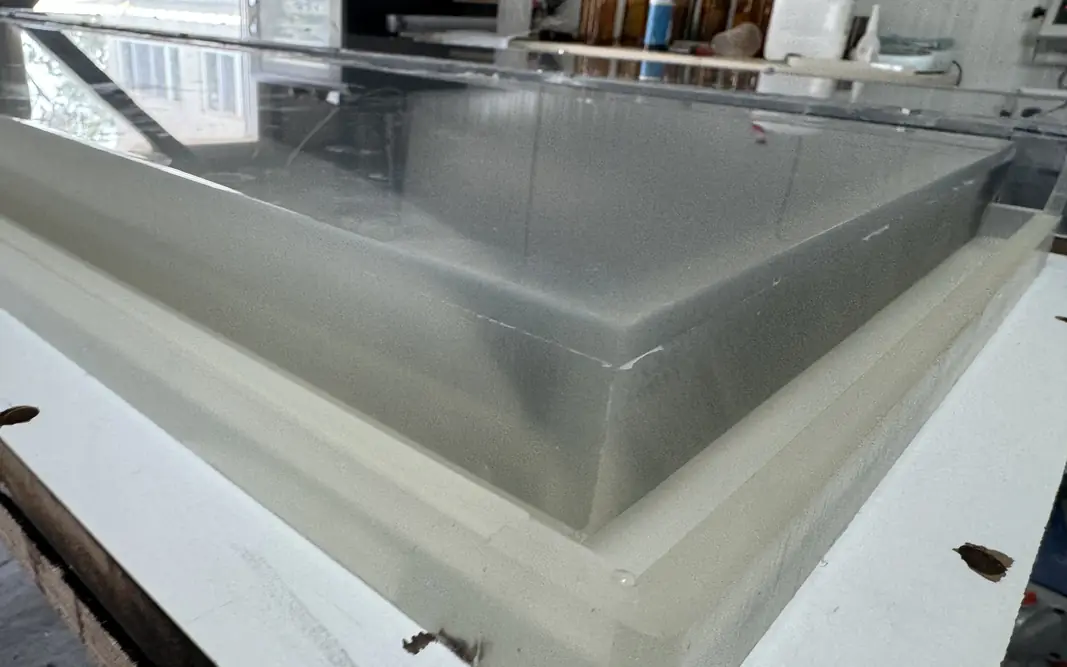
A poured fence is built in stages. Formwork is assembled along the whole length, the reinforcement is tied, the concrete is poured and left to gain strength before the formwork is removed. Then comes the finishing work. There is waiting time between stages, and the timeframe is set by the contractor.
A precast fence also involves concrete on site — in the post foundations. The posts are concreted into individual footings of about 40 × 40 × 80 cm or into a strip plinth of about 20 × 70 cm; which of the two is decided by the ground. The comparison is in the article footings or plinth.
Request a quote Send us the length and height — the quote is usually ready within 4 working hours.
Formwork and labour on site
Formwork is the biggest job with a poured fence. It must be accurate along the whole length, because the wall takes its shape: if the formwork warps, so does the wall. The reinforcement is placed in the formwork by hand, and the concrete is compacted so that no voids remain.
With a precast fence there is no formwork on site. The panel is a finished reinforced element — for most models 183 × 30 × 4–5 cm (thickness depending on the relief) and 46–61 kg depending on the model. Standard posts are 285 cm, of which 80 cm go into the ground; above 210 cm, reinforced K9i posts of 310 cm are used. With 183 cm panels, one bay between two posts is 1.90 m.
Concrete control: factory or site
The strength of concrete depends on the mix, on the amount of water and on how the concrete cures. In the factory, the Teka mixer batches all the ingredients automatically, so every batch has the same properties. We use 42.5R Portland cement and a 5th-generation superplasticiser that reduces the water needed. After casting, the panel cures in covered halls under an acrylic membrane that retains moisture. Compressive strength exceeds 55 MPa at 28 days.
On site, the same things depend on the people and on the day: what mix was delivered, whether water was added to it, how well it was compacted and whether the wall is kept moist while it cures. A good crew keeps these under control, but outdoor conditions change from day to day.
Weather and season
Pouring and curing depend on the weather outside: in cold, heat and rain, concrete needs extra measures or the work is postponed. The panels are not cast outdoors — production runs all year round. We install at temperatures above −5 °C and on snow-free ground; there are breaks only in the coldest weeks of January and February. In detail: fence installation in winter.
Appearance and relief
A poured wall bears the imprint of the formwork. It can be left as it is, clad, or rendered and painted.
Our panels are cast in two-component silicone moulds, so the relief has crisp detail. There are 22 models: geometric motifs, flowing lines, stone and wood relief, solid and openwork. The colour is in the concrete itself — grey for the standard panels, white for the premium panels made with white cement and marble aggregate, with no painting. The relief is on the front face; the back is unfinished and, if desired, can be skimmed with adhesive and fibreglass mesh at any time after assembly. All models are in the catalogue.
Repair and replacement
The panels are neither mortared in nor glued — they sit in the grooves of the posts. If a panel is struck, only that panel is replaced: the panels above are lifted, the new one goes in place of the old one and the rows are put back. With a monolithic wall, the repair is done on site, on the wall itself.
A concrete fence requires practically no maintenance. The warranty is 15 years, and the expected life is over 50 years. More in the article how long a concrete fence lasts.
Price: public or by quote
With us, the price is public and is per linear metre, with the panels and posts. For 18 of the 22 models it is the same: in grey 48, 56 and 63 €/m, in white 79, 92 and 104 €/m — at 150, 180 and 210 cm respectively, excl. VAT. Transport is stated in the quote, and installation is quoted separately, on request.
The price of a poured fence is quoted by the contractor. It covers the formwork, reinforcement, concrete, labour on site and finishing, and each item depends on the site. When you compare the two quotes, ask exactly what is included in the price per metre.
When a poured fence is the better choice
- Retaining wall. When the wall has to hold back soil across a large level difference, it is a separate structure, designed for the ground. That is where monolithic concrete belongs.
- Free form. Curves, angles at different degrees, a wall that follows the architecture of the house.
- Continuous wall. When you want a wall without visible posts, built together with other concrete work in the yard.
When a precast fence is the better choice
When you need a solid fence along the boundaries of your yard, quickly and at a predictable price. The elements arrive ready-made, assembly takes days, and on a slope the fence is stepped — each bay stays horizontal. If you are also undecided about the material, see the comparison concrete or metal fence.
Next step
Choose a model from the catalogue and see its price in the price list. Answers about the warranty, assembly and the back of the panel are in the frequently asked questions. Once you know the length and height, send an enquiry with a few photos of the site — you usually receive a quote for the elements and transport within 4 working hours.