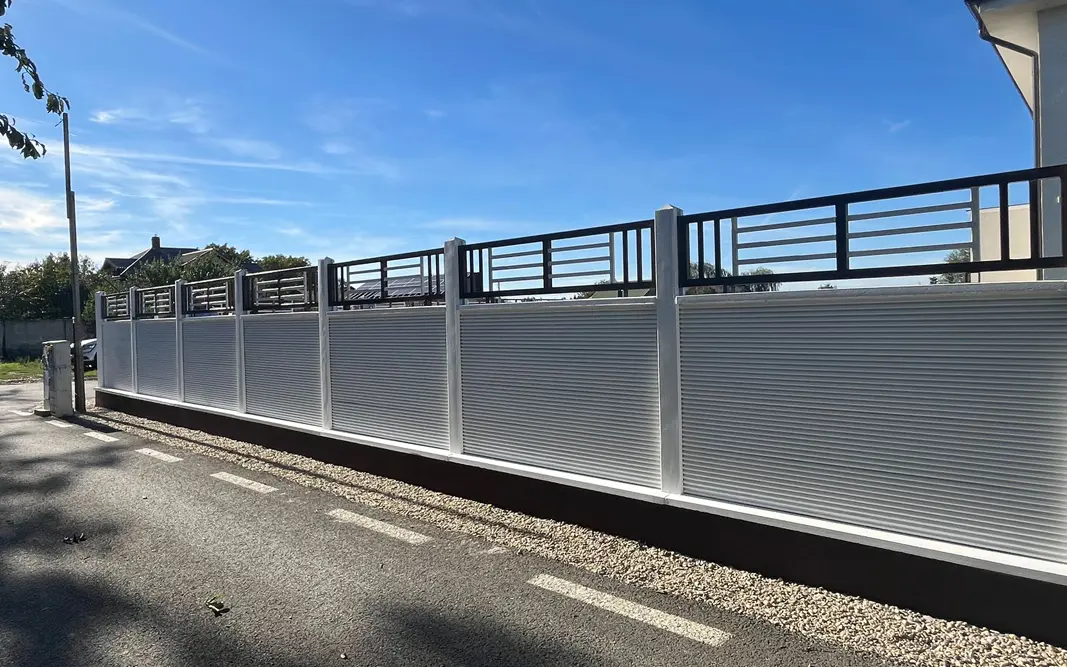
Concrete or brick fence — costs and timescales
A typical precast concrete fence is assembled in 2–3 days on prepared ground, and its price per linear metre is public. A brick fence is built on site over weeks, and its price depends on the crew and becomes clear as the work progresses.
A precast concrete fence comes ready-made from the factory and is assembled on site — a typical fence in 2–3 days on prepared ground. A brick fence is built on site brick by brick, with wet processes and waiting between stages; that means weeks. The price of the precast fence is per linear metre and you know it from the quote. With a brick fence, the total becomes clear as the work progresses.
Where the price of a brick fence comes from
A brick wall is manual work on site. The total is made up of four items, and each of them varies:
- materials — bricks, mortar, reinforcement, reinforced concrete columns;
- labour — the largest and least predictable item;
- foundation — a continuous strip foundation along the entire length, more massive than the one under a precast fence;
- render and paint — without them the wall does not look finished.
The result depends on the crew. With an inaccurate foundation or unstable ground the wall cracks; the repair is new render and new paint, which were not in the budget.
Where the price of a concrete fence comes from
With us the price is public and is per linear metre. The models and prices section lists all 22 models in four series — Modern Line, Simple Line, Aero Line and Nature Line. For 18 of the 22 models, the grey fence costs 48 €/m at 150 cm, 56 €/m at 180 cm and 63 €/m at 210 cm, and the premium white one — 79, 92 and 104 €/m respectively. Depending on the model and height, the fences are 37–78 €/m in grey and 61–129 €/m in white. For Liner, Simple, Rain Guard and Stacked Stone there is also an industrial offer — a lower price for fences on industrial and commercial sites, from 32 to 93 €/m; it applies to fences longer than 200 linear metres, in grey and in white, while shorter fences are charged at the model's standard prices. Prices are excl. VAT and are for the elements; transport is stated in the quote, and installation is quoted separately, on request.
Usually within 4 working hours of your enquiry you have a quote for the elements and transport. If you also want installation, once you confirm it we prepare a separate installation quote for your site. You sign a contract only once you know the full amount; the deposit is at least 20%. The balance is paid before each delivery — the value of the delivery minus the proportional part of the deposit; with a single delivery, the entire balance at once, before the fence leaves the factory. How the final figure is reached — in the article how much a concrete fence costs per linear metre; finished fences — in the gallery.
Request a quote Send us the length and height — the quote is usually ready within 4 working hours.
How long does each fence take?
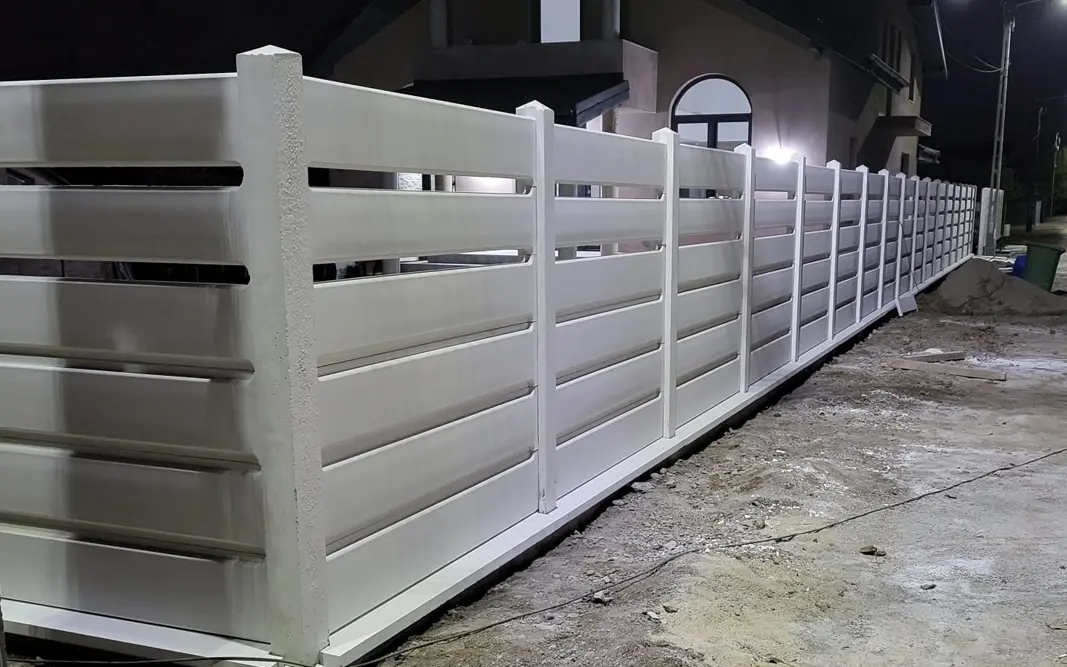
Installation of a typical concrete fence takes 2–3 days on prepared ground: we concrete the posts, stack the panels into their grooves and the fence is ready.
A brick fence goes in stages — excavation and foundation, waiting, bricklaying, waiting again, finally render and paint. In practice that means weeks, and bad weather extends them.
The panels are produced all year round in enclosed halls, and we install at temperatures above −5 °C on ground without snow; pauses occur only in the coldest weeks of January and February. Bricklaying and rendering are wet processes and simply stop in the cold. How assembly works in the cold months is described in the article fence installation in winter.
What foundation is needed?
Under a precast fence we dig either pad footings or a plinth. Pad footings are about 40 × 40 × 80 cm under each post — the cheaper option; the first row of panels is sunk 5–10 cm into the ground when the terrain allows, so there is no gap at the bottom. A strip plinth is about 20 × 70 cm along the entire line — for unstable ground or large level differences. Which of the two is decided by the terrain; the comparison is in the article pad footings or strip plinth.
Standard posts are 285 cm, of which 80 cm go into the ground; above 210 cm, we use reinforced 310 cm posts. The panels are ready-made elements — for most models 183 × 30 × 4–5 cm (thickness depending on the relief) and 46–61 kg (for Douglas and Cedar — 200 × 40 × 4–5 cm and 77 kg, for Stacked Stone — 200 × 50 × 4–5 cm and 82 kg). On site we simply stack them between the posts. That is why assembly takes days.
On sloping ground the precast fence is stepped: each section between two posts is horizontal, and the transition to the next level is at the post. A brick wall on a slope is built by hand, row by row, along the entire line. How a precast fence is assembled on a slope is described in the article fence on sloping ground.
What maintenance does each fence need?
A concrete fence requires practically no maintenance — no painting and no annual repairs. The panels are made of reinforced concrete with 42.5R Portland cement; they withstand freezing and thawing, moisture and sun. The service life is over 50 years, and the warranty — 15 years for all fences, including under the industrial offer, with a warranty card and a certificate of conformity. The warranty applies provided the fence is not treated with unsuitable materials — for example oils or cement in the joints between the panels. The full terms are in the warranty card.
A brick wall depends on its render: it cracks, absorbs moisture and sooner or later has to be renewed and repainted.
The back of the panels is unfinished. If you wish, it can be skimmed with adhesive and fibreglass mesh — at any time after assembly. More: how long a concrete fence lasts and whether it needs maintenance.
Strength, privacy and appearance
The panels are reinforced and sit one on top of another in the grooves of the posts, and each post goes 80 cm into the ground.
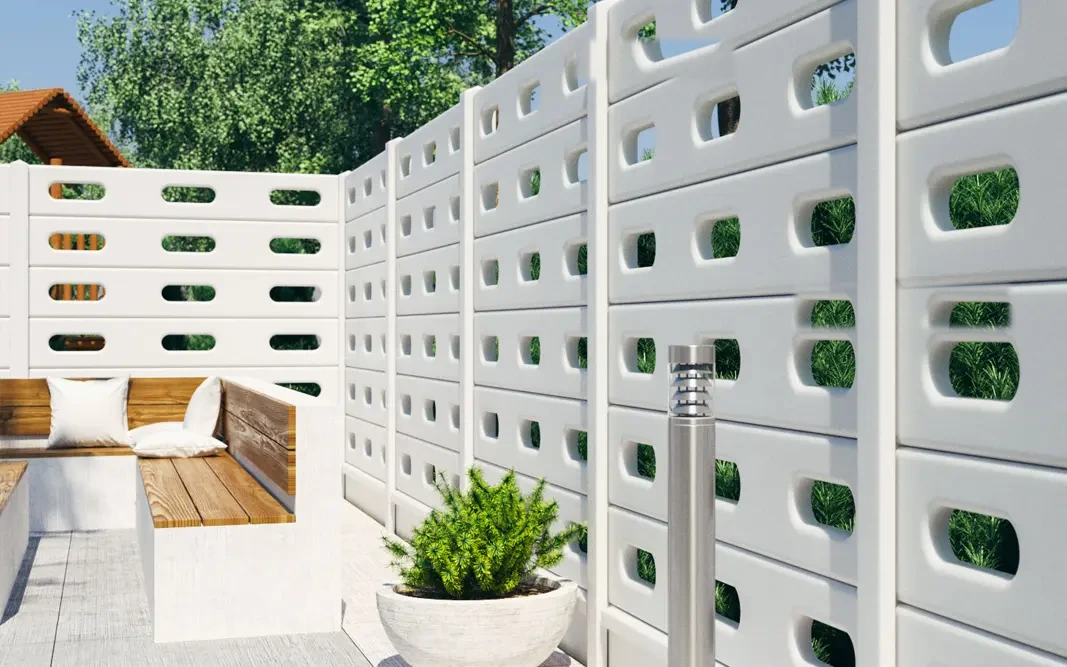
Privacy is the same. The solid panels are stacked without gaps and at 180 or 210 cm they screen the yard from the street — exactly like a wall. If you do not want a solid wall facing the street, see the openwork models in the Aero Line series — Lights, Avalon, Visio and Space: light passes through their openings.
A brick wall looks finished only after render and paint. With the panels, the relief is cast at the factory, and the colour is in the concrete itself — grey in the standard version, white in the premium version. There are 22 models: geometric motifs, flowing lines, stone and wood relief. If you like the look of masonry, Stacked Stone resembles a wall of layered rubble stone — thin stone strips laid in layers. How to narrow down your choice: the guide to choosing a model.
If you know the length of the fence and the height you want, send an enquiry — you will receive a quote for your site.