How to choose a concrete fence model — a guide
The choice comes down to four questions: what the fence is for, grey or white, which relief and what height. Prices are per linear metre and are public; four models also have an industrial price for fences over 200 linear metres.
The choice comes down to four questions: what the fence is for, grey or white, which relief and what height. The price is per linear metre and is public; the warranty is 15 years for all models, and the service life is over 50 years.
First: what the fence is for
For privacy you need a solid fence that is high enough. Solid panels are stacked without gaps; at 180 or 210 cm the yard cannot be seen from the street. If you do not need a solid wall, look at the openwork models of the Aero Line series — Lights, Avalon, Visio and Space: light passes through their openings.
Second: which category
Each of the 22 models has two prices — in grey and in white; four of the models also have a third, lower one for fences over 200 linear metres. Prices are excl. VAT and include the panels and the posts; transport is stated in the quote, and assembly is quoted separately, on request.
Standard (grey)
Grey reinforced concrete with Portland cement 42.5R. For 18 of the 22 models: 48 €/m at a height of 150 cm, 56 €/m at 180 cm and 63 €/m at 210 cm; across all models the range is 37–78 €/m depending on the model and the height.
Premium (white)
The same construction, with white Portland cement and marble aggregates. The colour is in the concrete itself, not in paint. The same 18 models cost 79 €/m at 150 cm, 92 €/m at 180 cm and 104 €/m at 210 cm; the range is 61–129 €/m.
Industrial offer
For Liner, Simple, Rain Guard and Stacked Stone there is also an industrial offer — a lower price per linear metre, in grey and in white: 32–93 €/m. It is designed for the long fences of industrial and commercial sites and applies to lengths over 200 linear metres; for shorter fences the model's usual prices apply. More on the industrial fences page.
All prices by model and height are in the price list.
Request a quote Send us the length and height — the quote is usually ready within 4 working hours.
Third: the texture
The 22 models are in four series — Modern Line, Simple Line, Aero Line and Nature Line. By relief they divide into stone, wood, geometry and calm panels; the openwork ones are in Aero Line.
Stone
Stacked Stone imitates a wall of stacked rubble stone — thin, uneven stone strips laid in layers. The panel is 200 × 50 cm, so there are fewer joints along the fence; the height is 150 or 200 cm. The model belongs to the Nature Line series and has an industrial price for fences over 200 linear metres.
Wood
Lightwood, Timberlap, Douglas and Cedar have a relief of wooden boards — from a shallow pattern on Lightwood to a pronounced grain on Douglas. On Timberlap the upper board projects in front of the lower one and casts a shadow; on Cedar there are four narrow boards, on Douglas two wide ones. The four models belong to the Nature Line series: they look like a wooden fence, but they do not need painting.
Geometry
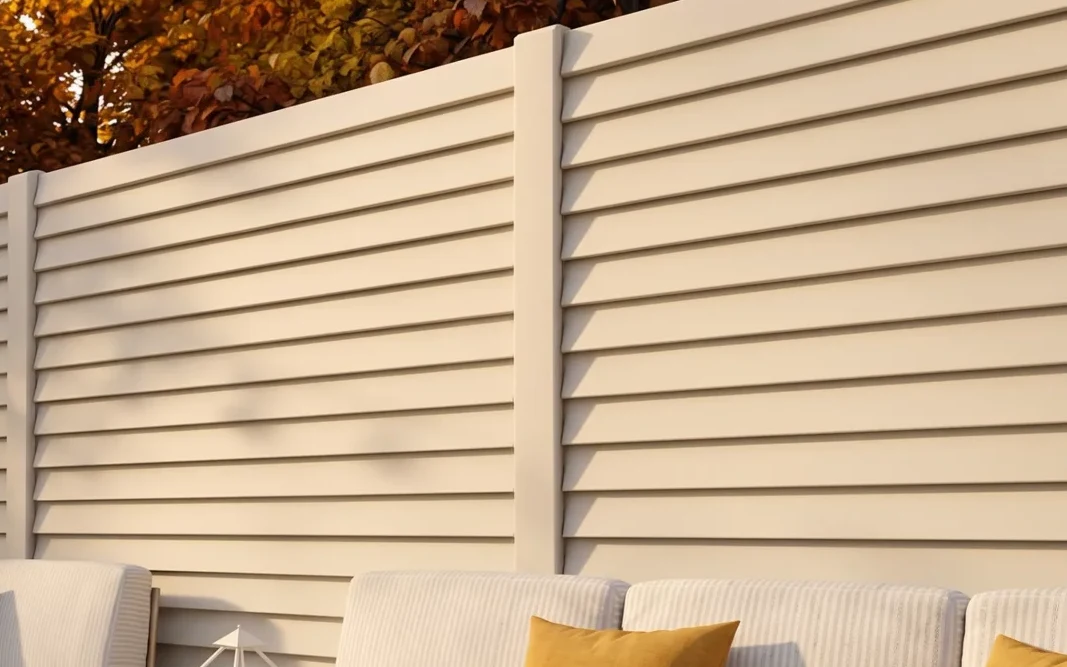
Rain Guard and Liner have horizontal lines and sharp edges: on Rain Guard the strips have a bevelled edge and a shadow falls under each one, on Liner the bands are straight, with narrow channels between them. They suit a house with a flat roof and long windows.
Calm panels
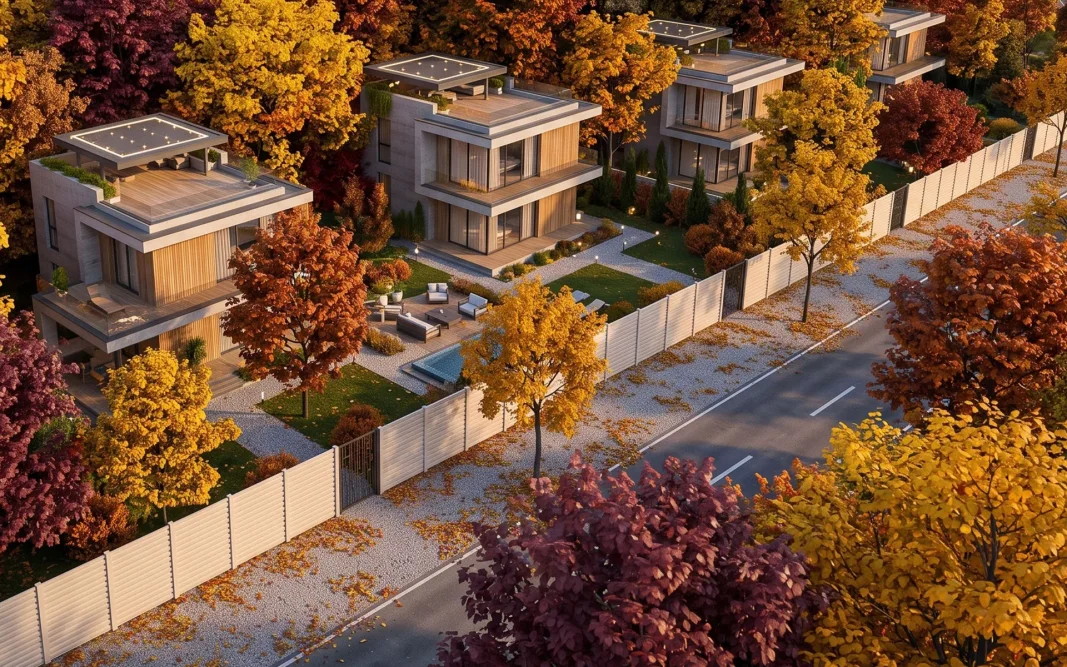
Simple is a smooth panel without relief, the face of Grande is a smooth field in a narrow frame, and Traditional has traditional motifs. If the façade already has a strong accent, choose a calm panel — Simple or Grande. You can see how the models look in real yards in the gallery.
Fourth: the height
Most models come in 150, 180 and 210 cm; Douglas and Cedar in 160 and 200 cm, Stacked Stone in 150 and 200 cm. For a residential yard 180 cm is the most common choice; 210 cm when the street is busy or the neighbouring building overlooks you. Before deciding, also check whether your municipality has requirements for fence height.
The height also determines the posts: the standard ones are 285 cm, of which 80 cm go into the ground; together with the first row of panels, set 5–10 cm into the ground, they are sufficient for fences up to 210 cm. With the 183 × 30 panels the posts are 1.90 m apart: one bay at 180 cm is 6 panels and one post. With reinforced K9i posts (310 cm) the 183 × 30 panels reach up to 240 cm — 8 rows; the price for 240 cm is in the price list.
The foundation under the fence
The fence stands either on pad foundations or on a strip foundation. Pad foundations are about 40 × 40 × 80 cm under each post — the cheaper option; with them the first row of panels is set 5–10 cm into the ground. The strip foundation is about 20 × 70 cm along the whole line — for unstable ground and for level differences, when the line has to be levelled. On a slope the fence is assembled in steps: each section between two posts stays horizontal. The details of assembly are described separately.
What else to keep in mind
The back of all panels is unfinished. On request it can be skimmed with adhesive and fibreglass mesh — at any time after assembly.
All fences — including those with an industrial price — come with a 15-year warranty, a warranty card and a certificate of conformity. The warranty applies provided the fence is not treated with unsuitable materials — for example oils or cement mix in the joints. The full terms and exclusions are in the warranty card.
We are often asked whether a precast fence is better than one cast on site. The panels are cast in enclosed halls to the same recipe, so every panel is identical to the others. With casting on site the result depends on the weather and on the crew. How this affects durability — in the article how long a concrete fence lasts.
Assembly of a typical fence — a few dozen to about 100 linear metres — takes 2–3 days on prepared ground with the materials delivered; for longer fences the timeframe is stated in the quote. Production runs all year round — the halls are enclosed. We install at temperatures above −5 °C on ground without snow, pausing only in the coldest weeks of January and February.
How to request a quote
When you have narrowed the choice down to two or three models, get in touch with us with the length of the fence and a photo of the site. You usually receive a quote for the elements and transport within 4 working hours; if you would like installation, once you confirm the quote we also prepare an installation quote for your site.