How long a concrete fence lasts and whether it needs maintenance
Why concrete lasts over 50 years, when cracks appear, how the 15-year warranty is preserved and which finishing is optional.
A precast concrete fence has a service life of over 50 years and a 15-year warranty. Under normal use it is not painted and needs no anti-corrosion treatment.
How many years does a concrete fence last?
A properly manufactured and properly installed concrete fence lasts over 50 years without major repairs. Concrete does not rot, rust or dry out. Look at the old concrete fences in villages — many date from the 1960s and 1970s and are still standing.
A wooden fence has to be impregnated every few years. A metal one has to be repainted wherever the coating has worn off. A concrete panel simply stays as it is.
Why it lasts so long
Production in covered halls
The panels are cast in our own factory, operating since 2011, in three covered halls. The mix is the same in August and in January, and the concrete cures indoors, so all elements come out identical. We use 42.5R Portland cement and conventional steel bar reinforcement; the standard panel is 183 × 30 × 4–5 cm (thickness depends on the relief) and weighs 46–61 kg depending on the model.
The foundation and the installation
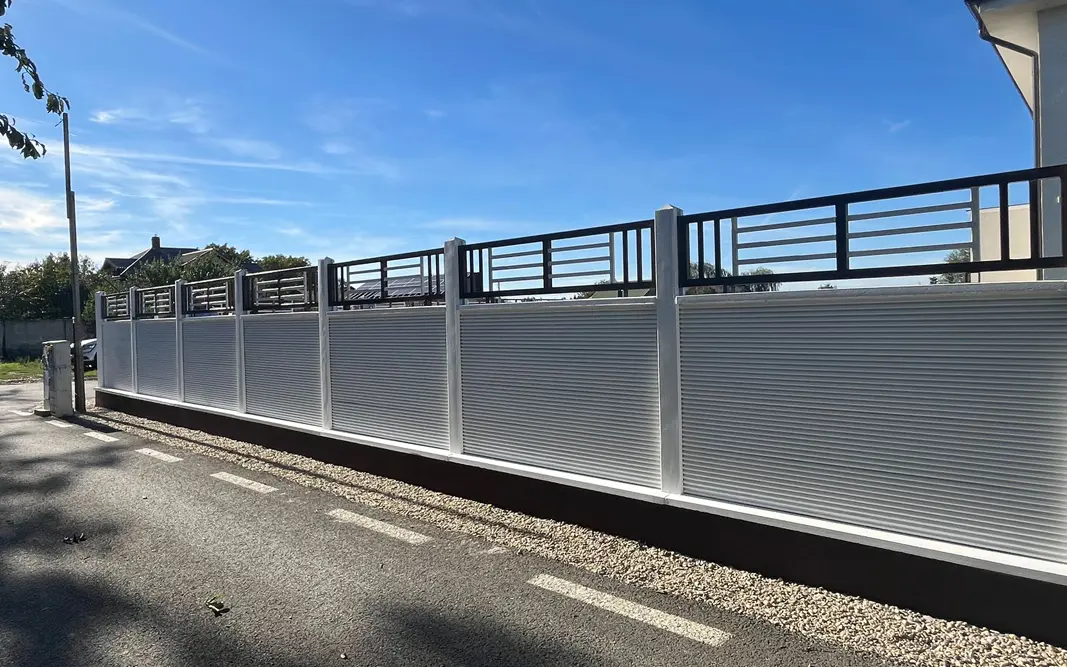
The other half of the work is underground. The posts are concreted into individual footings of about 40 × 40 × 80 cm, and the first row of panels is sunk 5–10 cm into the ground; on unstable soil or sloping ground the footings are tied together with a strip plinth of about 20 × 70 cm. Standard posts are 285 cm, of which 80 cm go into the ground — enough for a fence up to 210 cm; for a higher one we use reinforced 310 cm posts. A higher fence takes more wind load, so the foundation is matched to the height.
You will find details on the stages and timelines on the “How we work” page — the installation itself of a typical fence takes 2–3 days with the ground prepared and the materials delivered.
Frost, moisture and sun
The panels are resistant to frost, moisture and sun.
The reason is the density of the concrete. The less excess water there is in the mix, the fewer pores remain in the finished element and the less moisture it absorbs — and it is precisely water freezing in the pores that destroys poor-quality concrete from the inside. That is why the mix contains a superplasticiser that reduces the water in the mix, and the Teka mixer doses all the ingredients automatically — compressive strength exceeds 55 MPa at 28 days.
In winter too
Production runs all year round in the covered halls. Installation is possible at temperatures above −5 °C and on ground free of snow; the planned break in installation is during the coldest weeks of January and February. More on the topic in the article on winter installation.
Request a quote Send us the length and height — the quote is usually ready within 4 working hours.
Can a concrete fence crack?
If it is manufactured and installed correctly, the risk is minimal. A crack appears for four reasons:
- poor-quality concrete — porous, from a mix with excess water;
- insufficient reinforcement — the element cannot take the stresses and cracks or deforms over the years;
- a shallow or weak foundation — the fence settles and leans, and that is where cracks come from;
- installation “by eye” — without levelling and precise alignment of the elements.
The first two are a matter of production, the other two — of installation. So before choosing a fence on price per metre alone, ask how thick the panel is, how much it weighs, how it is reinforced and what foundation is planned.
Which foundation for which ground — in the article on individual footings and the strip plinth.
15-year written warranty
We give a 15-year warranty on all fences — for both residential and industrial sites — documented with a warranty card and a certificate of conformity.
Our clients include Glavbolgarstroy, the Bulgarian Army Stadium and Carrefour. You will see some of them in the project gallery.
How to keep the warranty valid
Finishing work must be done with suitable materials. Oils on the concrete and cement mortar in the joints between the panels are the two classic mistakes. The full list of conditions and exclusions is in the warranty card. If you are going to coat or paint anything on the fence, ask us first — the advice is free.
Does it need maintenance?
Practically none. Under normal use a precast concrete fence is not painted, treated against corrosion or impregnated.
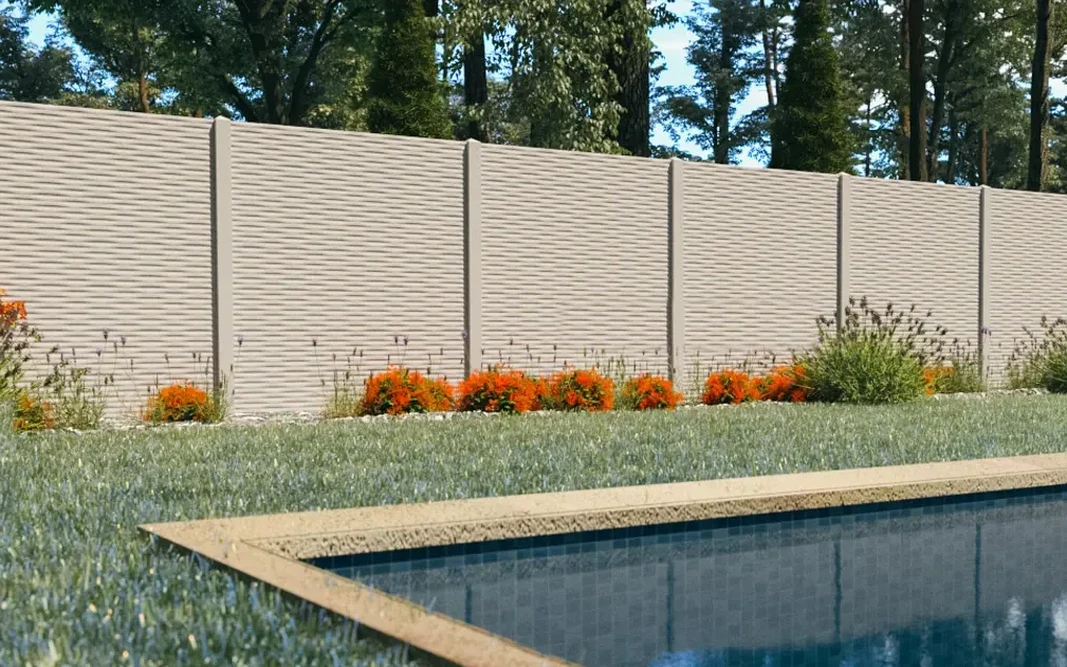
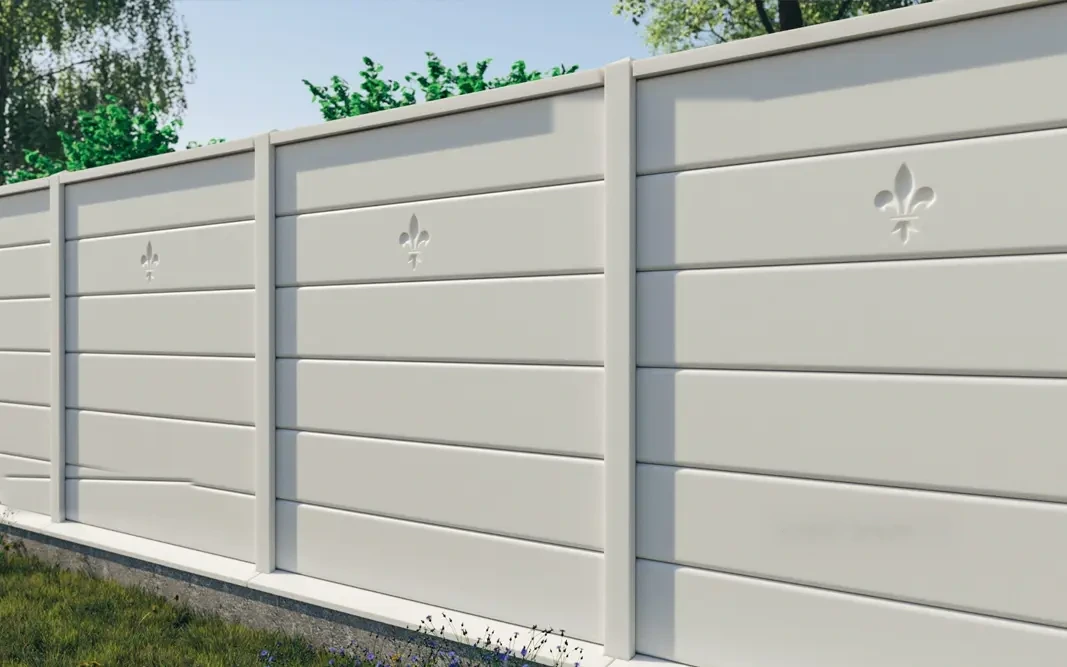
The standard grey colour and the premium white colour come from the concrete itself — in the white, from white Portland cement and marble aggregate in the body of the panel, not from a surface coating. There is no layer that has to be renewed on a schedule.
If you are comparing the models and prices with a wooden or metal fence, add to their price the paint and impregnation over the following years.
Finishing the back of the fence
The back of the panel is unfinished and can stay that way. If you want a smooth surface on the garden side, it is skimmed with adhesive and fibreglass mesh — at any time after installation, not necessarily straight away. Painting is optional too: the fence lasts without it.
Next step
Send us the length, height and site address via the contact form — you usually receive a quote for the elements and transport within 4 working hours; if you want installation, after confirmation we also prepare a quote for it, according to the site.