Types of garden fences — concrete, metal, wire mesh or wood
Six types of garden fence — concrete, metal, wood, mesh and gabions, masonry fence and hedge — compared on what decides the choice: how much of the yard they screen, what maintenance they need, how they are installed and how they cope with a slope.
There are six main types of garden fence: concrete from precast panels, metal, wooden, mesh or gabions, masonry and hedge. If you need a solid fence that does not need painting, concrete meets both conditions: it is a wall, and the colour is in the concrete itself. Our price is public — from 37 to 129 €/m excl. VAT, including the panels and the posts. If you want the garden to be visible from the street, look at mesh, metal fencing or the openwork concrete models.
Comparison of garden fence types
| Type | Does it screen the garden | Maintenance | Installation | Price per linear metre |
|---|---|---|---|---|
| Concrete panels | yes; the openwork models — partly | no painting; the colour is in the concrete | the posts are set in concrete, the panels are stacked in their grooves | from 37 €/m excl. VAT, in the price list |
| Metal | only solid sheet metal | paint and rust protection where the coating is damaged | posts in concrete or fence on a plinth | quoted by the contractor |
| Wooden | yes, with tightly spaced boards | impregnation and painting every few years | posts in concrete | quoted by the contractor |
| Mesh | no | low with galvanised or PVC-coated mesh | stretched between metal posts | usually the lowest at purchase |
| Gabions | yes | low | wire baskets with stone on a level, compacted base | depends on the stone and the base |
| Masonry (brick, blocks) | yes | render and paint | strip foundation, bricklaying, rendering — in stages, over weeks | depends on the builders |
| Hedge | after years of growth | regular trimming and watering | planting | depends on the plants |
We do not give figures for the other types. Their price depends on the material, the contractor and the site, and we have no verified data that would apply across Europe. Our price is for the elements; transport is stated in the quote. Installation is quoted separately, on request.
Solid garden fence
A solid fence is one through which the garden cannot be seen from the street. Of the types in the table, these are concrete, masonry, gabions, wooden with tightly spaced boards and metal made of solid sheet metal.
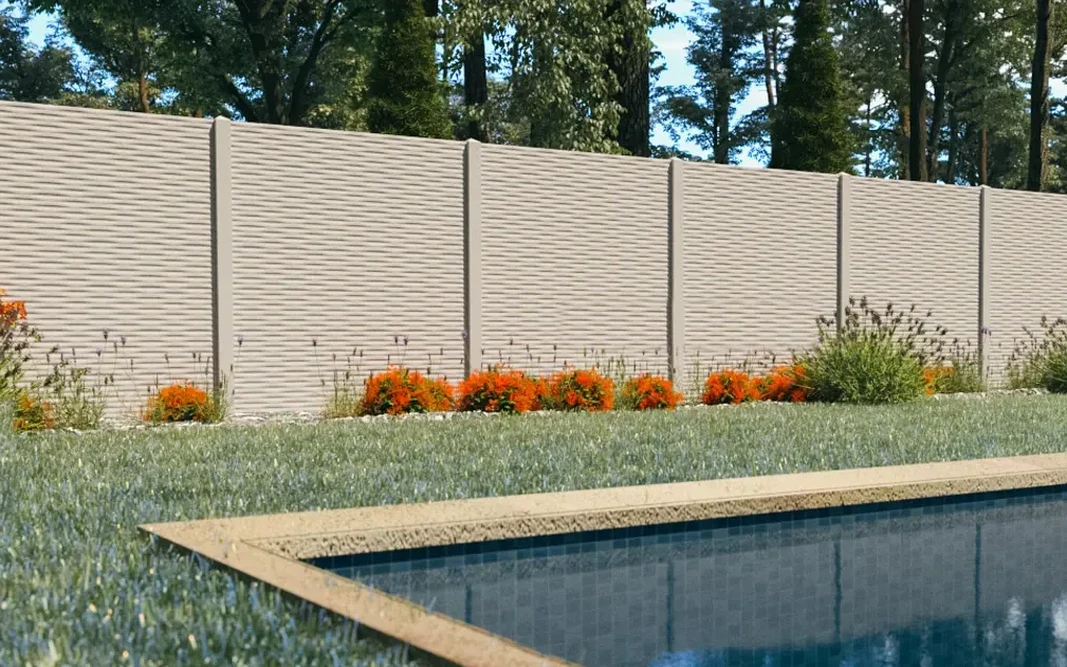
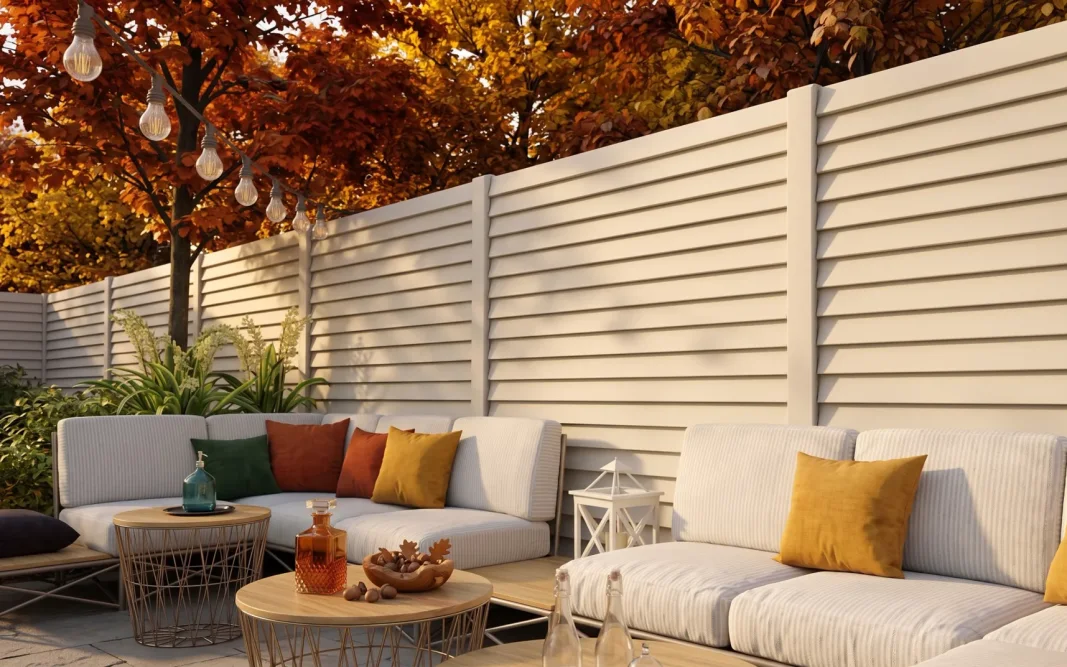
The difference is in the mass. Sheet metal is a thin sheet: it blocks the view but does little to muffle noise. A concrete fence is a wall. The panel is 183 × 30 × 4–5 cm (thickness depending on the relief), reinforced, and sits in the grooves of the posts with no gap to the next row. For most models the heights are 150, 180 and 210 cm, and with reinforced K9i posts — also 240 cm.
The relief is on one side, and the back is left unfinished. If it matters to you how the fence looks from behind as well, the back can be skimmed with adhesive and fibreglass mesh at any time after assembly.
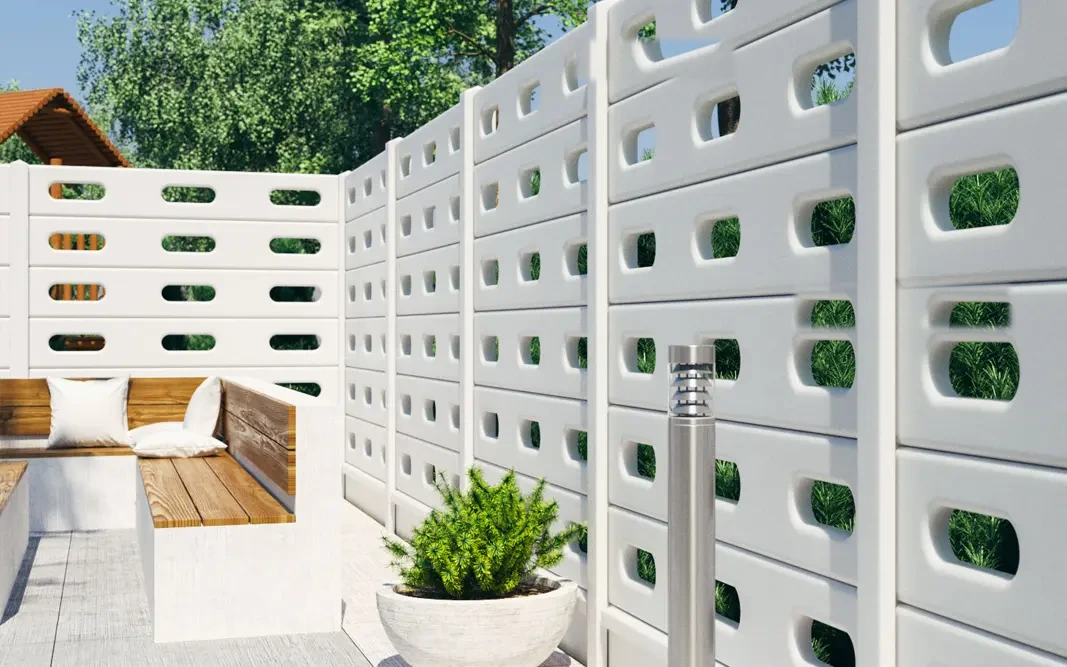
If you want only partial privacy, there are openwork concrete models — the Aero Line series: Lights, Avalon, Visio and Space. They let light through openings or slots. Solid and openwork panels can be combined: the lower rows solid, the upper ones openwork. Another option is a mixed fence: solid concrete along the side boundaries and at the back of the property, lighter and openwork towards the street.
Request a quote Send us the length and height — the quote is usually ready within 4 working hours.
Durability and maintenance
This is where the types differ most, because the cost comes after installation.
- Metal. Steel rusts where the coating is damaged — at welds, cut edges and scratches. Galvanising and powder coating delay this, while ordinary paint has to be renewed every few years.
- Wood. It is impregnated and painted periodically. The most vulnerable part is near the ground, where moisture is retained.
- Mesh. Galvanised and PVC-coated mesh need no painting; damaged spots are treated.
- Masonry fence. The render and paint are renewed as on a façade.
- Hedge. It is trimmed several times a year and takes years to become dense.
A concrete fence requires practically no maintenance. The colour is in the material itself: grey for the standard panels, white for the premium panels made of white cement and marble aggregate. So there is no paint to renew. The warranty is 15 years, and the expected life of the fence is over 50 years. More in the article how long a concrete fence lasts.
Price per linear metre
For a concrete fence, the price per linear metre includes the panels and the posts. For 18 of the 22 models it is the same: in grey 48, 56 and 63 €/m, in white 79, 92 and 104 €/m — at 150, 180 and 210 cm respectively, excl. VAT. Across all models the range is 37–78 €/m in grey and 61–129 €/m in white. Prices by model, colour and height are in the price list.
When you compare quotes for different types of fences, ask what is included in the price per metre: the posts or pillars, the foundation, the paint, the installation. Mesh is almost always cheaper to buy. For a made-to-order metal fence, the price is set by the workshop — depending on the metal and the complexity of the design.
Installation
A concrete fence arrives ready-made from the factory. The posts are set in concrete in individual footings of about 40 × 40 × 80 cm or in a strip plinth of about 20 × 70 cm, then the panels are slid into their grooves. A typical fence of up to about 100 linear metres is ready in 2–3 days on prepared ground. Both types of foundation and the installation steps are described on the installation page.
Metal and wooden fences also stand on posts set in concrete or on a plinth. A masonry fence is built on site, in stages, with waiting time between them. A hedge is planted quickly, but it takes years to become a dense fence.
Fence on sloping ground
On a slope, mesh is the most flexible: it is stretched to follow the ground. A made-to-order metal fence can be built in steps or follow the slope. A masonry fence is built in steps.
A concrete panel is rigid and cannot be tilted, so the fence is installed in steps. Each bay between two posts stays horizontal, and the change to the next level is made at the post. With 183 cm panels, one bay is 1.90 m. How the level difference is handled and which foundation to choose — in the article on fences on sloping ground.
Concrete or metal fence for your garden?
A metal fence is the better choice when you want the garden to be visible from the street. A concrete one — when you need a solid wall that never needs painting. The detailed comparison of maintenance, wind and price is in the article concrete or metal fence. Comparisons with the other types too: concrete fence or mesh fence and concrete or brick fence.
Next step
If you have chosen a concrete fence, browse the 22 models in the catalogue and calculate your fence in the “Order online” block on the model page. For the warranty, installation and the back of the panel, see the frequently asked questions. Or send an enquiry with the length and height — you usually receive a quote for the elements and transport within 4 working hours.