White and grey concrete fences — colour in the concrete, no painting
The colour of a concrete fence can come from the concrete itself or from a coating applied after installation. What the difference is, which colours the Konkret Line models come in, and what to bear in mind if you decide to paint the fence.
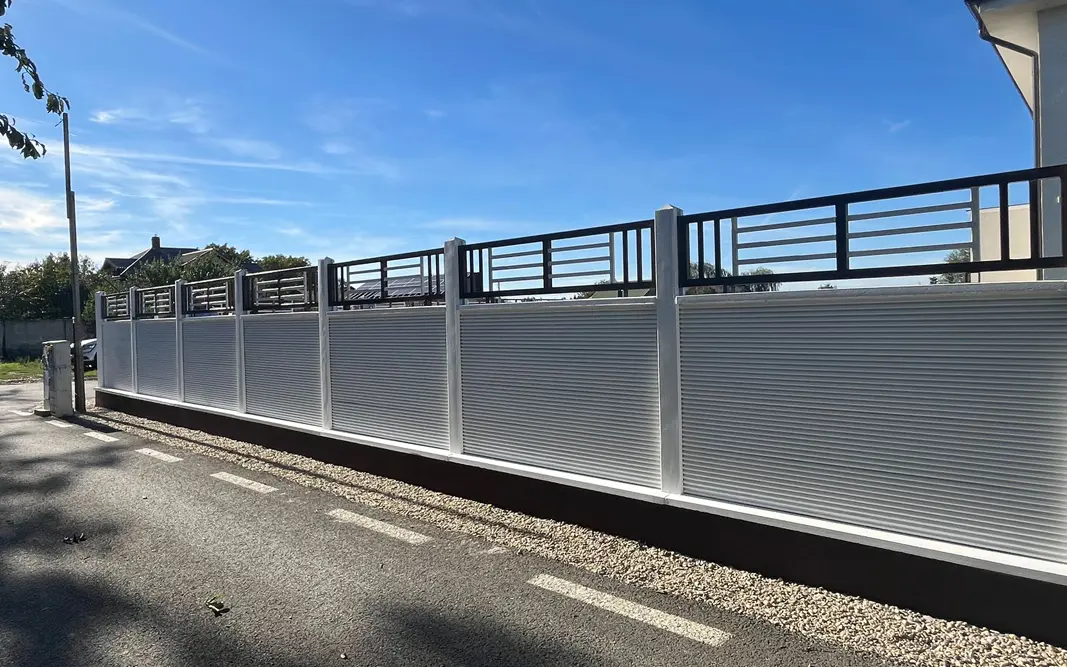
In a photo, two white fences can look identical yet be made in completely different ways: in one, the colour is in the concrete itself; in the other, it is in a layer of paint on top of it. The difference shows after a few years, when the painted one has to be painted again.
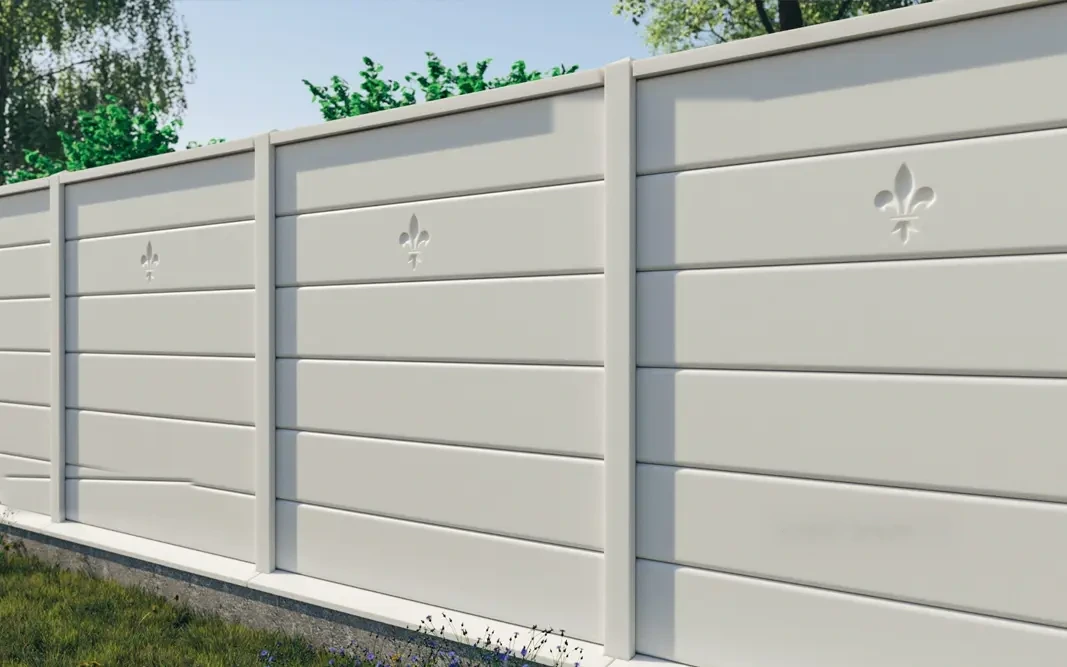
At Konkret Line, both colours — grey and white — are in the concrete itself.
How is concrete coloured?
The colour of a concrete fence is obtained in two ways: during production, in the concrete itself, or after installation — with a coating on the finished surface.
Colour through the mass. The colouring happens in the mix itself — with pigments or through the choice of the raw materials themselves: the cement and the aggregates. The surface is matt. There is no coating to peel, and a scratch reveals the same colour underneath.
Coating after installation. This is a paint or a semi-transparent (glaze) coating applied to the finished fence. The palette is practically unlimited, but the colour is only in a thin layer on the surface: sun and rain age it, and sooner or later it has to be renewed.
| Criterion | Colour through the mass | Coating applied after installation |
|---|---|---|
| Where the colour is | in the concrete itself | in a thin layer on the surface |
| Choice of colours | whatever the manufacturer offers | practically unlimited |
| If scratched | the same colour is underneath | the concrete beneath the layer shows through |
| Renewal | no layer to renew | periodically — depending on the paint and exposure |
What colours do Konkret Line fences come in?
All 22 models are available in two colours — and in both, the colour is in the concrete itself:
- Standard grey — the natural colour of concrete made with 42.5R Portland cement.
- Premium white — the panels are made with white Portland cement and marble aggregate. The white tone is not paint but a different material — which is also where the higher price comes from.
For most models — 18 out of 22 — the grey version costs 48, 56 and 63 €/m, and the white one 79, 92 and 104 €/m, at heights of 150, 180 and 210 cm respectively. Across all models, grey costs 37–78 €/m and white 61–129 €/m, depending on the model and height. Prices are excl. VAT and include the panels and posts; transport is stated in the quotation, and installation is quoted separately, on request. You will find the price of every model at every height in the price list.
Four models — Liner, Simple, Rain Guard and Stacked Stone — also have an industrial price, lower per linear metre, for fences longer than 200 linear metres — in grey and in white; for shorter fences the model's usual prices apply. More about industrial fences.
Request a quote Send us the length and height — the quote is usually ready within 4 working hours.
Grey or white fence — which should you choose?
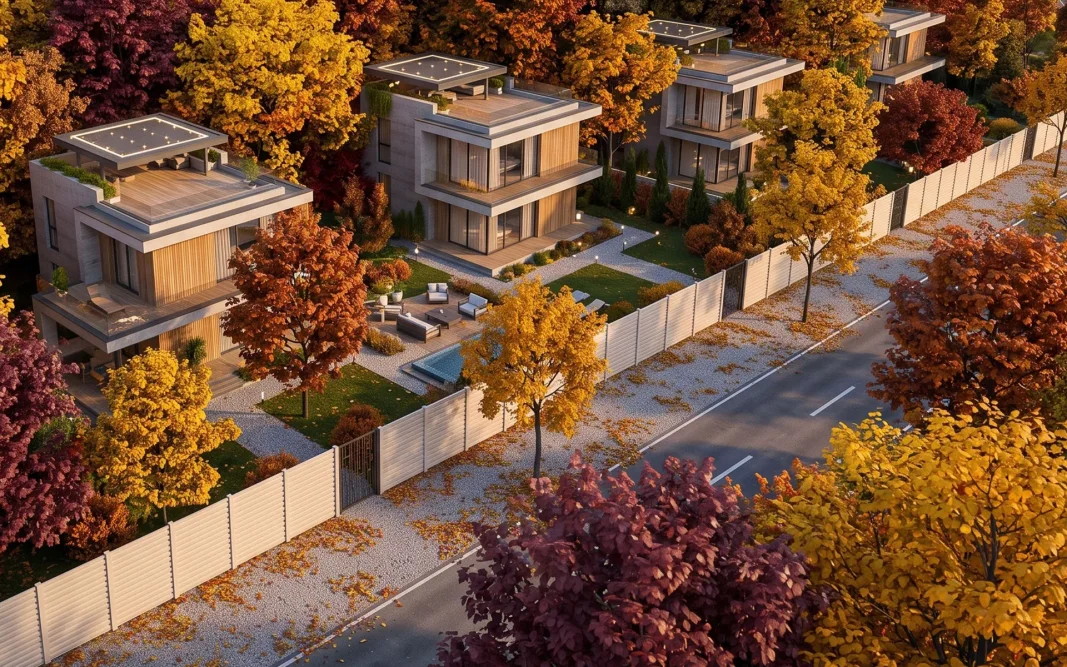
- Grey goes well with exposed concrete, dark window frames, wood and stone, and is a calm backdrop for the greenery in the garden. After rain, grey takes on a deeper tone, and once it dries it lightens again.
- White suits light-coloured façades. A white fence looks best when there is grass, gravel or paving at its base.
You can see how the two colours look in real gardens in the gallery. If you are still choosing a model, also read the article on a concrete fence for a modern garden.
Does a concrete fence need painting?
No. The panels are resistant to frost, moisture and ultraviolet radiation, and the fence requires practically no maintenance — no painting and no yearly repairs. Both the grey and the white colour are in the body of the panel, so there is no coating to renew on a schedule. More on the subject in the article how long a concrete fence lasts.
Paint it only if you want a specific colour — for example the shade of the façade or of the window frames. Along with the paint you also get a layer that you will have to look after from then on.
What should you bear in mind if you decide to paint the fence?
- Ask us in advance. The warranty applies when the fence is treated with suitable materials — no oils or cement in the joints between the panels; the full conditions are in the warranty card. Before you buy paint, write to us with the product you have chosen — the advice is free.
- Choose a paint for outdoor concrete. Concrete is a porous and alkaline material. You need a façade paint that its manufacturer explicitly recommends for outdoor mineral substrates — interior paints are not designed for this.
- The coating must “breathe”. A vapour-permeable paint lets moisture escape from the concrete. A dense, impermeable film traps it and over time blisters and peels.
- Work on a clean, dry surface. Dust, dirt and moisture under the paint are the most common cause of peeling. Follow the manufacturer's instructions on primer, temperature and drying time.
- Do a test. The colour of the sample and the colour on textured concrete in the sun differ. Paint a small area in an inconspicuous spot and inspect it in daylight once it has dried.
- Be careful with dark shades. They heat up more in the sun, and fading shows on them sooner.
How are the back of the fence and the plinth finished?
The panels' relief is on the front face, while the back is left untreated. If you wish, it can be skimmed with a thin layer of adhesive with embedded fibreglass mesh for exterior use — at any time after installation. On the garden side you are left with a flat surface that can be finished like a façade — in the colour of the house, if you like. See also the article on a fence with relief on both sides.
If the fence stands on a strip plinth, part of it remains visible above the ground — exactly how much depends on the slope of the plot. The plinth can be rendered or clad later, so here too you can repeat the colour or material of the house. When a plinth is needed is explained in the articles individual footings or a strip plinth and a fence on sloping ground.
The same applies to this work: agree the materials with us in advance.
How to choose and get a quotation?
Grey and white give you a colour that never needs renewing. For a different shade, write to us before you buy the paint.
Browse the models and prices and send an enquiry with the length of the fence, the height and the colour. You usually receive a quotation for the elements and transport within 4 working hours; if you want installation, after confirmation we also prepare a quote for it, according to the site.