Coping for a concrete fence and plinth cap — price and sizes
What the KA300 coping and the KA400 plinth capping are, which models they go with, how many pieces one fence needs and how much they cost in grey and in white.
The fence cap (coping, KA300) and the plinth cap (KA400) are the two accessories for the models with 183 cm panels. Both are optional. You need one per bay, not one per post. One piece costs 9 € (KA300) and 15 € (KA400) in grey, excl. VAT.
Below is what they are, which models they go with, how many pieces your fence needs and which mistakes are made most often when ordering.
What KA300 and KA400 are
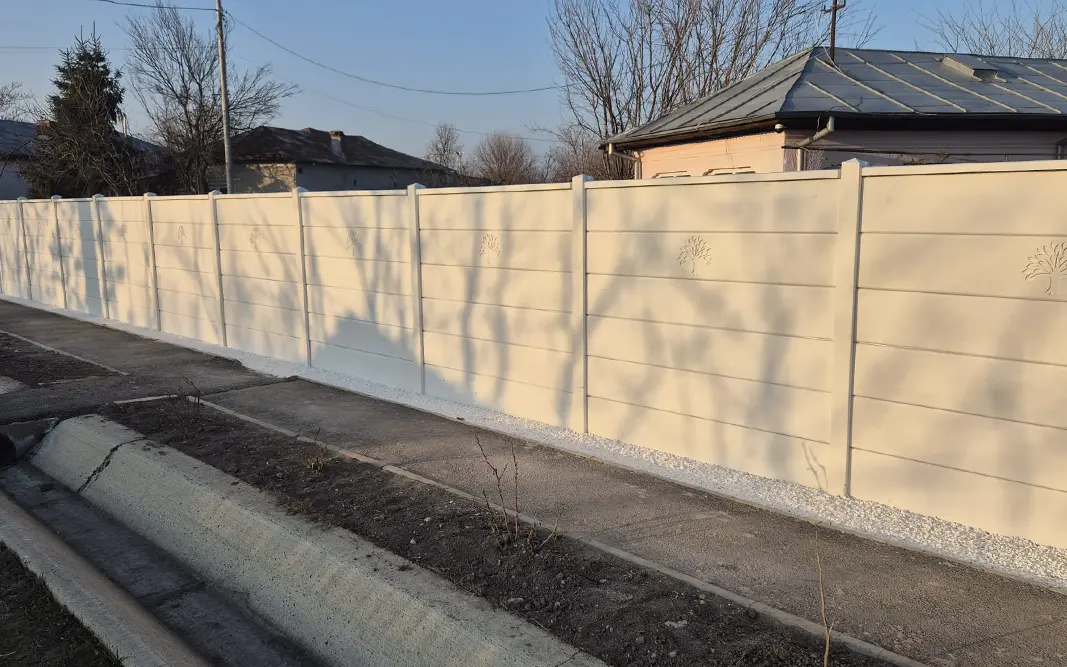
KA300 — fence cap (coping). A concrete element 183 cm long, the same length as the panel. It finishes the fence at the top. It can be ordered both for installation on individual footings and with a strip plinth.
KA400 — plinth cap. Also 183 cm long, but wider and heavier. It covers the strip plinth within one bay. That is why it goes only with a strip foundation (plinth) and is not used for installation on individual footings.
| KA300 — coping | KA400 — plinth cap | |
|---|---|---|
| Dimensions | 183 × 13 cm | 183 × 30 × 7 cm |
| Weight | 20 kg | 49 kg |
| Price in grey, excl. VAT | 9 € / pc | 15 € / pc |
| Price in white, excl. VAT | 15 € / pc | 25 € / pc |
| Quantity | one per bay | one per bay |
| Foundation | individual footings or plinth | strip plinth only |
Which models they go with
The caps are offered only for panels 183 cm long. These are all models with a 183 × 30 cm panel and Space (183 × 31.5 cm). There are no caps for Stacked Stone (panel 200 × 50 cm), Douglas and Cedar (200 × 40 cm).
The type of post does not change the caps. They are counted by bays and are as long as the panel. That is why they are the same for the K9 intermediate posts, the reinforced K9i and the K14 end posts.
Request a quote Send us the length and height — the quote is usually ready within 4 working hours.
How many caps a fence needs
A bay is the section between two posts. With 183 cm panels, one bay is 1.90 m. The calculation is the same as for the panels:
- Bays = the length ÷ 1.90 m, rounded up to a whole number.
- Posts = the bays + 1 for a straight line.
- Caps = the bays — one KA300 and, if there is a plinth, one KA400 per bay.
There is one more post than there are bays, while the caps equal the number of bays. The full calculation for the panels and posts is in the article how many concrete panels and posts a fence needs.
Example: 25 metres
A straight 25 m fence with 183 cm panels has 14 bays and 15 posts. The caps are 14 + 14:
- 14 × KA300 in grey: 126 € excl. VAT, in white — 210 €;
- 14 × KA400 in grey: 210 € excl. VAT, in white — 350 €;
- both caps together in grey: 336 € excl. VAT.
For comparison: the panels and posts for the same 25 m of the Simple model at a height of 180 cm cost 1,491 € in grey. The two caps add 24 € per bay in grey and 40 € per bay in white.
Grey or white
The caps are made in the two colours of the fence — grey and white. In the configurator they are calculated in the colour you have chosen for the fence. White is more expensive for the caps too, as it is for the panels and posts. More about the two colours: colours and finishes for a concrete fence.
Are the caps mandatory
No. The caps are separate elements and are selected optionally. The prices in the price list — both per panel and per linear metre — are without caps.
The visualisation on the page of every model with a 183 cm panel shows the fence with both caps. If you want the fence to look like it does there, select them when ordering. If the installation is on individual footings, only the KA300 coping remains.
How to order them
Choose a model from the catalogue and open its page. In the first step of the order there is an “Accessories” block with the two checkboxes. When you select a cap:
- its price is added to the total for the elements, and the price per linear metre is recalculated;
- its weight is included in the delivery calculation — 20 kg for the coping and 49 kg for the plinth cap per bay;
- the caps are carried over into the enquiry, together with the model, the length and the posts.
If you select the plinth cap together with installation on individual footings, the block shows a warning. Choose a plinth or remove the cap.
Installation
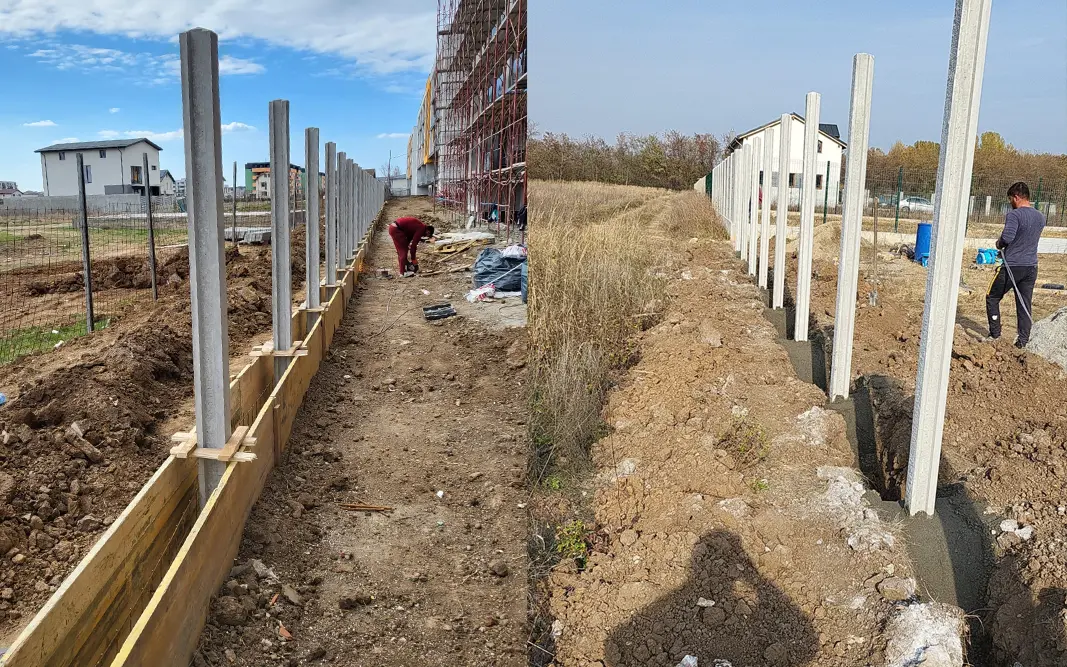
The type of base decides which cap can be used. With individual footings of about 40 × 40 × 80 cm under each post there is only the coping. With a strip plinth of about 20 × 70 cm both caps can be fitted. The difference between the two bases is described in installation and in the article individual footings or strip plinth.
Installation is quoted separately. First you receive the quote for the elements and the delivery, and if you want installation, we also prepare a quote for it.
Common mistakes
The quantity is calculated by posts. There is one more post than there are bays. If you order caps by the number of posts, you will have one extra cap of each type.
Plinth cap without a plinth. KA400 goes only with a strip foundation. With individual footings, the plinth cap is not used.
Caps for 200 cm panels. Stacked Stone, Douglas and Cedar have 200 cm panels. There are no KA300 and KA400 caps for them.
Comparison with the price per metre from the price list. The price per metre in the price list is without caps. When you select them in the configurator, the metre comes out more expensive, and that is to be expected.
Forgotten weight. 14 plinth caps weigh 686 kg. That is why their weight is included in the delivery calculation.
Other questions about ordering and delivery are collected in the frequently asked questions.